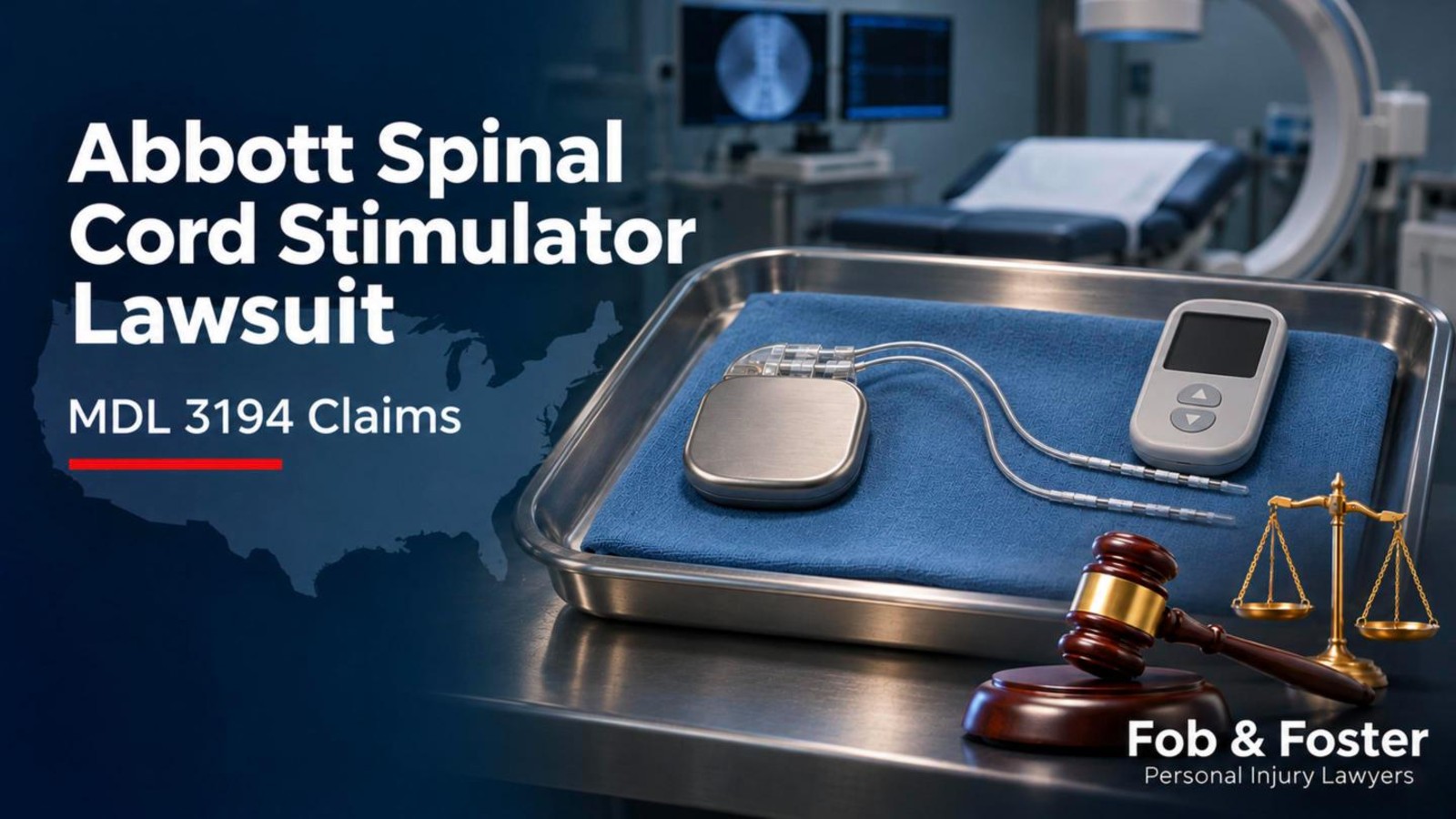
Abbott Spinal Cord Stimulator Lawsuit November 2026 Status: MDL 3194 is pending before Judge Lindsay C. Jenkins in the Northern District of Illinois with 27 cases as of November 2, 2026. The court holds its first hearing November 12, 2026. Discovery is paused, no lead counsel has been appointed and there is no direct filing order yet. No case has been tried or settled. Call (205) 407-6009 for a free case review.
Lawsuits over Abbott’s spinal cord stimulators, including the Proclaim and Eterna systems and older St. Jude Medical devices, are now centralized in a federal multidistrict litigation in Chicago. The Judicial Panel on Multidistrict Litigation created MDL 3194 on October 2, 2026 and assigned it to Judge Lindsay C. Jenkins of the Northern District of Illinois. There were 27 cases pending on November 2, 2026, and the court’s first hearing is November 12, 2026. No Abbott stimulator case has been tried or settled.
This page tracks the Abbott litigation: the latest court dates, the devices named, what the lawsuits allege, Abbott’s recall history, who may qualify and how long you have. Fob & Foster Personal Injury Lawyers review Abbott stimulator claims for patients in Alabama, Georgia, Tennessee and North Carolina. The call is free: (205) 407-6009. For the other manufacturers, see our main spinal cord stimulator lawsuit guide.
Filing Deadline Warning: The Abbott MDL has no direct filing or tolling order, so only a filed lawsuit stops the clock. Your state sets the deadline: one year in Tennessee, two years in Alabama and Georgia, three years in North Carolina, often counted from the first sign of trouble and not from the removal surgery. Older St. Jude implants can also run into outer limits. Call (205) 407-6009 or toll-free (866) 837-1010 to have your dates checked.
Abbott Spinal Cord Stimulator Lawsuit Updates
Latest Update, November 10, 2026: Judge Jenkins holds the first hearing in MDL 3194 on November 12, 2026 at 10:00 a.m. at the Dirksen Courthouse in Chicago. The court has said it will not choose the plaintiffs’ lead lawyers at the hearing but will set the process for choosing them. Discovery remains paused. The Judicial Panel’s November 2 report lists 27 cases pending. No case has been tried or settled.
Earlier updates are listed newest first. Select one to read it.
October 13, 2026: Case Management Order No. 1
The court’s first order paused all discovery, terminated the motions that were pending in the transferred cases so they can be refiled in an orderly way, and set the November 12 hearing. It did not create a direct filing procedure.
October 2, 2026: MDL 3194 Created
The Judicial Panel centralized 26 Abbott cases from thirteen districts before Judge Lindsay C. Jenkins in the Northern District of Illinois, where ten cases were already pending and where Abbott is headquartered. It declined to send the cases to the Boston Scientific judge.
June 22, 2026: Plaintiffs File a New Abbott Petition
After the Panel’s June 5 ruling, plaintiffs filed a second request for an Abbott proceeding as cases accumulated in more districts.
June 5, 2026: Panel Declines an Abbott MDL for Now
The Panel created a Boston Scientific MDL but turned Abbott down because all four Abbott cases then on file were in a single district, which left nothing to centralize.
February 20, 2026: First Request for an MDL
Plaintiffs asked the Panel to centralize spinal cord stimulator cases, including cases against Abbott.
July 2023: Class I Recall of Proclaim and Infinity Generators
Abbott issued a correction, classified by the FDA as a Class I recall, for generators that could fail to exit MRI mode. It covered more than 155,000 devices in the United States and was handled with instructions and a software update.
Why Abbott Has Its Own MDL
Abbott was part of the first request for a stimulator MDL in February 2026, alongside Boston Scientific. On June 5, 2026 the Panel created a Boston Scientific proceeding and turned Abbott down for a procedural reason: all four Abbott cases then on file were already in one district, the Northern District of Illinois, and the Panel cannot centralize cases that are not spread across districts. Plaintiffs filed a new petition on June 22. By the time the Panel ruled there were 26 Abbott cases in thirteen districts.
The Panel sent the cases to Chicago because ten were already pending there and because Abbott is headquartered in the district. It declined the plaintiffs’ suggestion to assign them to the Boston Scientific judge in California, writing that “little efficiency will be gained by placing SCS device MDLs against multiple manufacturers before one judge.” It also noted the “overlap in threshold proceedings regarding preemption,” a signal that Abbott’s federal preemption defense will be decided early.
Which Abbott Stimulators Are Named
The Panel’s order covers Abbott spinal cord stimulators generally and does not list models. The devices named in the lawsuits filed so far are:
- Proclaim XR and Proclaim Plus, non-rechargeable generators that the patient controls from a phone or handheld app
- Proclaim DRG, which stimulates the dorsal root ganglion and is used for complex regional pain syndrome of the lower limbs
- Eterna, Abbott’s small rechargeable system
- Older St. Jude Medical systems such as Eon and Prodigy. Abbott completed its acquisition of St. Jude Medical in January 2017 and inherited its neuromodulation business.
Abbott’s Infinity system, which appears in the 2023 recall discussed below, is a deep brain stimulator, not a spinal cord stimulator, and is not part of this litigation.
What the Abbott Lawsuits Allege
The Panel described the common questions as Abbott’s regulatory compliance, its use of the FDA’s premarket approval supplement process, and the conduct of its sales representatives. In plainer terms, plaintiffs allege that Abbott’s current stimulators are the product of a long chain of changes to a device approved years ago, more than 230 of them according to one complaint, each cleared through a supplement without new clinical trials; that Abbott did not warn patients and doctors about shocks, burns, lead migration and loss of therapy; and that its representatives programmed devices and reassured patients in ways that amounted to practicing medicine. Patients report injuries that include painful shocks and jolts, burning at the generator site, leads that moved or broke, devices that stopped working, new nerve symptoms, and revision or removal surgery. Abbott denies the allegations.
Abbott’s Recall History
In July 2023 Abbott issued a correction, classified by the FDA as a Class I recall, for Proclaim and Infinity implantable generators that could fail to exit MRI mode, leaving the patient without therapy. It covered more than 155,000 devices distributed in the United States between 2015 and 2023. Abbott reported 186 incidents and 73 injuries and addressed the problem with instructions and a software update; it did not ask for devices to be removed, although the FDA noted that a device that could not be restored might have to be surgically replaced.
Abbott has issued other corrections since. In 2024 it told doctors that the interval between a Proclaim’s battery-replacement warning and the end of the battery’s life could be much shorter than labeled. In 2025 it issued a correction for Eterna generators that could lose Bluetooth communication, in some cases requiring another procedure. A lawsuit does not depend on any of these, and most Abbott plaintiffs’ injuries have nothing to do with MRI mode. The recalls matter as evidence of what Abbott knew about its devices and when.
What Happens Next in MDL 3194
Judge Jenkins entered Case Management Order No. 1 on October 13, 2026. It pauses all discovery, terminates motions that were pending in the transferred cases so they can be refiled in an orderly way, and sets an in-person hearing for November 12, 2026 at the Dirksen Courthouse in Chicago. The court has said it will not choose the plaintiffs’ lead lawyers at that hearing but will set up the process for doing so. After leadership is appointed, expect a master complaint, Abbott’s motion to dismiss on preemption grounds, and eventually an order allowing new cases to be filed directly in the MDL. As of the court’s first order there was no direct filing procedure, so a new Abbott case is filed in the patient’s home federal court and transferred.
Who May Qualify for an Abbott Stimulator Claim
- You received a permanent Abbott or St. Jude Medical spinal cord or DRG stimulator.
- You then had shocks or burning, lead migration or fracture, loss of therapy, a serious infection, or new nerve, bowel or bladder problems.
- You needed a revision, replacement or removal, a hospital stay or repeated reprogramming, or were told to turn the device off.
- Your state’s deadline has not passed: one year in Tennessee, two in Alabama and Georgia, three in North Carolina, usually counted from the first sign of trouble and not from the removal.
Your implant card, the Abbott app on your phone or the operative report will confirm the model. Do not turn off or remove a device on your own account; that is a decision for you and your doctor.
How Long Do You Have to File a Abbott Claim?
The court handling Abbott cases does not set your deadline. Your state does, and the four states we serve differ sharply:
| State | Deadline to sue for injury | Outer limit | State guide |
|---|---|---|---|
| Tennessee | 1 year | 6 years from injury or 10 years from first purchase | Tennessee guide |
| Alabama | 2 years | 20-year common-law rule of repose | Alabama guide |
| Georgia | 2 years | 10 years from first sale for strict liability claims | Georgia guide |
| North Carolina | 3 years | 12 years from initial purchase | North Carolina guide |
The Abbott MDL is new and has no direct filing or tolling order. Until one is entered, the clock stops only when a lawsuit is filed in a federal court with jurisdiction, after which the case is transferred to Chicago. Patients with older St. Jude Medical systems should have the implant date checked against the outer limits in the table.
What to Do If Your Abbott Stimulator Has Caused Problems
Your Health Comes First: Do not turn off, stop charging or seek removal of your stimulator because of a lawsuit or a recall notice. Those are medical decisions to make with your doctor. If you have sudden weakness or numbness, loss of bowel or bladder control, fever, or signs of infection at the implant site, get medical care right away.
- Tell your doctor. Report each symptom and ask that it go in the chart. Turning the device off, changing its settings or scheduling a removal are medical decisions, not steps to take for a lawsuit.
- Confirm what you have. Your implant card, the Abbott patient controller app or handheld controller, and the operative report identify the generator and leads. Records from before 2017 may list St. Jude Medical as the manufacturer.
- Write down the dates: the implant, the first problem, each reprogramming visit, any instruction to turn the device off, and every revision or removal.
- Keep the hardware. If the device is coming out, tell the surgeon and the hospital in writing beforehand that you want the generator and leads preserved and not sent back to the manufacturer.
- Save what the company representative told you: texts, emails and voicemails.
- Have the dates checked. The deadline may already be running.
How Fob & Foster Handle Abbott Stimulator Claims
The review is free and starts with a phone call about your device, the dates and the treatment you have needed. We tell you whether the claim appears to be within your state’s deadline and whether it is the kind of injury these cases involve. If we take the case, we gather the implant and operative records, confirm the model and file it in federal court so that it is transferred to MDL 3194 in Chicago. We work on a contingency fee: no fee unless we recover money for you, and we explain the fee agreement in writing before you sign anything. Call (205) 407-6009 or send us a message.
Abbott Spinal Cord Stimulator Lawsuit FAQs
Is there an Abbott spinal cord stimulator class action?
No. Abbott cases are individual lawsuits coordinated in MDL 3194 in the Northern District of Illinois. Each patient has a separate case, and any recovery depends on that patient’s own injuries.
Has Abbott settled any spinal cord stimulator lawsuits?
No. As of November 2026 there has been no settlement and no verdict in an Abbott stimulator product liability case, and the MDL has not set trial dates.
Was my Abbott Proclaim recalled?
Proclaim XR, Proclaim Plus and Proclaim DRG generators distributed between 2015 and 2023 were covered by Abbott’s July 2023 MRI-mode correction, which the FDA classified as a Class I recall. It was handled with instructions and software, not by removing devices. Ask your pain clinic whether your device was affected and updated.
Are St. Jude Medical stimulators included?
Lawsuits have named older St. Jude Medical systems as well as current Abbott devices, because Abbott acquired St. Jude in 2017. Older implants raise deadline and repose questions, so the implant date should be checked first.
Where are Abbott spinal cord stimulator lawsuits filed?
They are coordinated in MDL 3194 before Judge Lindsay C. Jenkins in the Northern District of Illinois. There is no direct filing order yet, so a new case is filed in the patient’s home federal court and transferred to Chicago for pretrial proceedings.
How long do I have to file an Abbott stimulator claim?
Your state’s law sets the deadline: one year in Tennessee, two years in Alabama and Georgia, and three years in North Carolina. The time often starts when the device first gives you reason to suspect it, not when it is removed.
Do I have to have my Abbott stimulator removed to file?
No. Claims also involve revision or replacement surgery, hospital care, repeated reprogramming and devices a doctor has said to turn off. Removal is a medical decision to make with your physician.
How much does it cost to have an Abbott claim reviewed?
Nothing. The review is free, and Fob & Foster Personal Injury Lawyers handle these claims on a contingency fee: no fee unless we recover money for you.
Related Practice Areas
- Spinal Cord Stimulator Lawsuit (National Guide)
- Boston Scientific Spinal Cord Stimulator Lawsuit
- Nevro Spinal Cord Stimulator Lawsuit
- Medtronic Spinal Cord Stimulator Lawsuit
- Alabama Spinal Cord Stimulator Lawsuit
- Georgia Spinal Cord Stimulator Lawsuit
- Tennessee Spinal Cord Stimulator Lawsuit
- North Carolina Spinal Cord Stimulator Lawsuit
- Spinal Cord Stimulator Lawsuit Update
- Spinal Cord Stimulator Verdicts and Settlements
- Boston Scientific Infinion CX Lead Recall
- Bard PowerPort Lawsuit
- AngioDynamics Port Catheter Lawsuit
- Medtronic Bravo Capsule Recall Lawsuit
- Defective Products Lawyers