
Spinal Cord Stimulator Lawsuit November 2026 Status: Three federal MDLs are open: Boston Scientific (MDL 3181, Central District of California, 62 cases), Abbott (MDL 3194, Northern District of Illinois, 27) and Nevro (MDL 3195, Northern District of California, 24), 113 cases in all as of November 2, 2026. Medtronic cases are not centralized. The Abbott court holds its first hearing November 12, Boston Scientific’s motion to dismiss the master complaint is due November 20, and the Nevro court first meets December 18. No case has been tried or settled. Call (205) 407-6009 for a free case review.
Spinal cord stimulator lawsuits claim that the implanted pain devices made by Boston Scientific, Abbott, Nevro and Medtronic shocked and burned patients, moved out of place, stopped working or caused new nerve damage, and that the manufacturers changed the devices repeatedly without new safety testing and did not warn patients or doctors. In 2026 the federal courts grouped the cases into three separate proceedings, one for each of three manufacturers. As of November 2, 2026, 113 lawsuits were pending in them. No case has gone to trial and none has settled.
This page explains where the litigation stands, which devices are involved, who may have a claim, what the manufacturers’ main defense is, and how long you have to act. Fob & Foster Personal Injury Lawyers review spinal cord stimulator claims for patients in Alabama, Georgia, Tennessee and North Carolina. The call is free: (205) 407-6009.
Filing Deadline Warning: Your deadline is set by your state’s law, not by the MDL, and it can be short: one year in Tennessee, two years in Alabama and Georgia, three years in North Carolina. The clock can start at the first sign the device is causing harm, such as being told to turn it off, and not at the removal surgery. Do not wait for a recall or a settlement. Call (205) 407-6009 or toll-free (866) 837-1010 to have your dates checked.
What Is the Spinal Cord Stimulator Lawsuit?
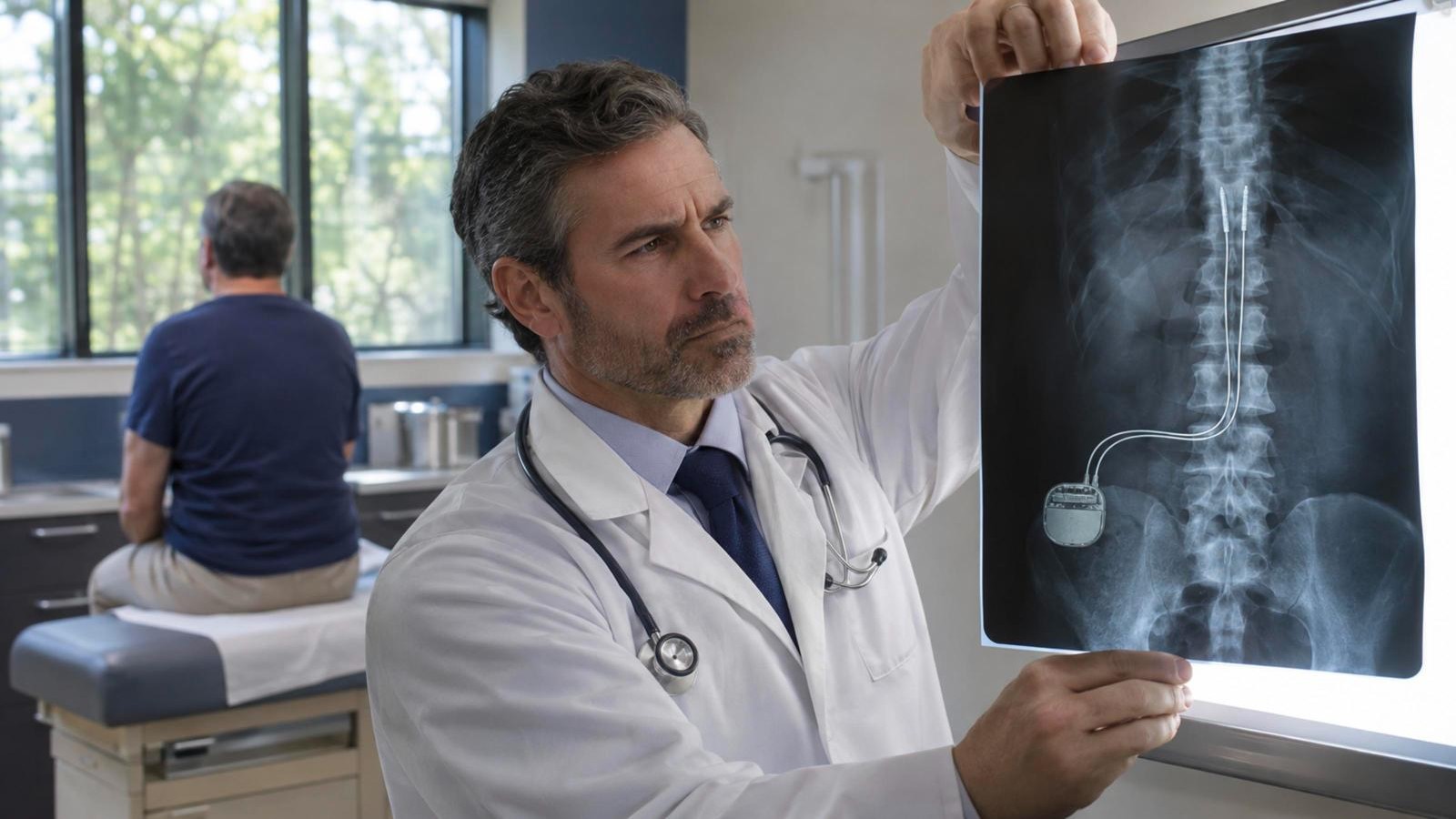
A spinal cord stimulator is a small battery-powered generator, usually implanted under the skin of the lower back or buttock, connected to thin wires called leads that sit in the space next to the spinal cord. The generator sends mild electrical pulses through the leads to interrupt pain signals before they reach the brain. Doctors implant them for chronic back and leg pain, pain after failed back surgery, complex regional pain syndrome and painful diabetic neuropathy. The U.S. Food and Drug Administration has estimated that about 50,000 are implanted each year.
The lawsuits are product liability claims against the companies that make the devices. They are not claims against the doctors who implanted them. Patients allege that their stimulators delivered sudden shocks and jolts, burned at the battery site, overstimulated or stopped stimulating, that leads migrated or fractured, and that many patients needed one or more additional surgeries to revise, replace or remove the device. Some allege permanent nerve injury, weakness, and loss of bowel or bladder control.
These are individual lawsuits, not a class action. Each patient files a separate case with separate injuries and separate damages. The cases are then coordinated before one judge for the shared questions, such as what the manufacturer knew and what it told the FDA, in a proceeding called a multidistrict litigation, or MDL. If an MDL ends in a settlement, each person’s payment depends on that person’s own injuries. The manufacturers deny the allegations, and no court has yet decided whether any of these devices is defective.
The Three Spinal Cord Stimulator MDLs
Plaintiffs first asked the Judicial Panel on Multidistrict Litigation for one industry-wide proceeding covering every manufacturer. The Panel refused. In its June 5, 2026 order it wrote that the plaintiffs “do not allege the manufacturers acted in concert” and that each manufacturer “has its own line of SCS devices, each of which have their own regulatory histories.” It created a Boston Scientific proceeding that day. Four months later, on October 2, 2026, it created separate proceedings for Abbott and Nevro, again declining to put them in front of the Boston Scientific judge because “little efficiency will be gained by placing SCS device MDLs against multiple manufacturers before one judge.”
| Manufacturer | MDL | Court and judge | Created | Cases pending (Nov. 2, 2026) | Next date |
|---|---|---|---|---|---|
| Boston Scientific | MDL 3181 | Central District of California, Judge Josephine L. Staton | June 5, 2026 | 62 | Motions to dismiss due Nov. 20, 2026; status conference Dec. 4, 2026 |
| Abbott (including former St. Jude Medical devices) | MDL 3194 | Northern District of Illinois, Judge Lindsay C. Jenkins | Oct. 2, 2026 | 27 | Initial conference Nov. 12, 2026, Chicago |
| Nevro | MDL 3195 | Northern District of California, Judge Haywood S. Gilliam, Jr. | Oct. 2, 2026 | 24 | Leadership applications due Nov. 30, 2026; initial conference Dec. 18, 2026, Oakland |
| Medtronic | None | Individual cases in several courts, including the District of Minnesota | Not applicable | Not reported by the Panel | None set |
Case counts are from the Panel’s November 2, 2026 report of pending MDL dockets. They count lawsuits, not people, and a single lawsuit can include more than one plaintiff. The counts have climbed every month since June: the Boston Scientific docket alone went from 41 cases at the start of October to 62 at the start of November.
Boston Scientific: MDL 3181
The Boston Scientific proceeding is the furthest along. Judge Staton appointed the plaintiffs’ leadership team on August 13, 2026 and five days later entered a direct filing order, which lets a patient anywhere in the country file a new Boston Scientific case straight into the MDL in California instead of filing at home and waiting for a transfer. Under that order a directly filed complaint stops the clock on the filing date, although it cannot revive a claim whose deadline has already passed. The plaintiffs filed their consolidated master complaint on October 23, 2026. Boston Scientific’s motion to dismiss it is due November 20, 2026, and the court has status conferences set for December 4, 2026 and for February, March and April 2027. The court has also separated a second track of claims that challenge the FDA’s own handling of the device approvals under the Administrative Procedure Act; a hearing on that track will not happen before February 5, 2027. More detail is in our post on the Boston Scientific spinal cord stimulator lawsuit.
Abbott: MDL 3194
The Abbott cases are in Chicago, where Abbott is headquartered and where ten of the cases were already pending. Judge Jenkins entered her first case management order on October 13, 2026. It pauses all discovery and sets the first hearing for November 12, 2026, where the court will take up how the plaintiffs’ lead lawyers will be chosen. There is no direct filing order in the Abbott MDL yet. See our post on the Abbott spinal cord stimulator lawsuit.
Nevro: MDL 3195
The Nevro cases are before Judge Gilliam in Oakland, who was already handling twelve of them. His first pretrial order, entered October 14, 2026, pauses discovery and pending motions, takes applications for the plaintiffs’ leadership positions through November 30, 2026, and sets the first in-person conference for December 18, 2026. The Panel’s order notes that the lawyers who asked for the MDL said they represent about 300 potential plaintiffs. See our post on the Nevro spinal cord stimulator lawsuit.
Medtronic: no MDL
Medtronic stimulator cases have not been centralized, and no request to centralize them is pending. They are proceeding one at a time, several of them in federal court in Minnesota, where Medtronic is based. The most important ruling in the whole litigation so far came from that court in July 2026 and is discussed below, because it shows both of the ways these cases are lost: preemption and deadlines. Our post on the Medtronic spinal cord stimulator lawsuit covers what that means for patients.
Which Spinal Cord Stimulators Are Involved?
The Panel’s orders centralize cases by manufacturer and do not list models. The device names below are the product lines identified in the lawsuits filed so far.
| Manufacturer | Stimulator systems named in lawsuits |
|---|---|
| Boston Scientific | Precision, Precision Plus, Precision Spectra, Precision Montage and Montage MRI, Precision Novi, Spectra WaveWriter, WaveWriter Alpha and WaveWriter Alpha Prime |
| Abbott | Proclaim XR, Proclaim Plus, Proclaim DRG and Eterna, and older St. Jude Medical systems such as Eon and Prodigy |
| Nevro | Senza, Senza II, Senza Omnia and HFX iQ |
| Medtronic | Intellis, Vanta, Inceptiv and the Restore family |
How to find out which stimulator you have
Many patients know they have “a stimulator” but not who made it. There are four easy ways to find out. The implant identification card you were given after surgery names the manufacturer, model and serial number. The patient remote or charger carries the manufacturer’s name, and so does the phone app if your device is controlled by one. The operative report from the implant surgery lists every component by model and lot number, and the hospital or surgery center must give you a copy on request. And the company representative who programmed your device worked for the manufacturer. You do not need to have this sorted out before you call a lawyer; we can get the records.
Injuries and Complications Reported by Patients
The Panel’s Boston Scientific order summarizes the injuries pleaded in the cases as unsatisfactory pain relief, shocking, burning, lead migration, autonomic dysfunction and neurological injuries. Across the lawsuits against all four manufacturers, patients describe:
- Shocks and jolts: sudden, painful surges of stimulation, sometimes triggered by movement, charging or nothing at all
- Burning or overheating at the generator site, especially during charging
- Lead migration or fracture: the wires move away from the target or break, so stimulation is lost or lands in the wrong place
- Loss of therapy: the device stops relieving pain, shuts off, or cannot be recharged or reprogrammed
- Worse pain than before the implant, or new pain at the battery pocket
- Nerve injury: new numbness, weakness, foot drop, difficulty walking, and in the most serious cases paralysis
- Bowel, bladder or other autonomic problems that began after the implant
- Infection, spinal fluid leaks and skin erosion over the hardware
- Revision, replacement or removal surgery, often more than once
Your Health Comes First: Do not turn off, stop charging or seek removal of your stimulator because of a lawsuit or a recall notice. Those are medical decisions to make with your doctor. If you have sudden weakness or numbness, loss of bowel or bladder control, fever, or signs of infection at the implant site, get medical care right away.
What the Lawsuits Allege the Manufacturers Did Wrong
Spinal cord stimulators are Class III medical devices, the FDA’s highest-risk category, and reach the market through premarket approval, or PMA. A manufacturer that later wants to change an approved device can ask the FDA to approve the change through a PMA supplement, which usually requires far less evidence than the original application. The lawsuits are built on how the manufacturers are said to have used that system. The Panel’s orders describe four common allegations:
- Approval on borrowed evidence. Plaintiffs allege that Boston Scientific won its original approval by relying on published studies of other companies’ stimulators instead of clinical trials of its own.
- Abuse of the supplement process. Plaintiffs allege that each manufacturer then used a long series of supplements to bring out substantially different devices, with new batteries, new waveforms, new leads and new software, without new clinical testing. The Panel’s Nevro order records the allegation that nearly 250 new stimulator devices reached the market this way. Boston Scientific’s current systems all trace back to a single approval, PMA P030017, first granted in 2004.
- Failure to warn and concealment. Plaintiffs allege the companies knew from their own complaint files how often the devices shocked patients, migrated and failed, and did not tell patients, doctors or the FDA what they knew.
- Sales representatives acting as clinicians. Company representatives commonly attend the implant surgery and then program and reprogram the device at follow-up visits. Plaintiffs allege that representatives made treatment decisions they were not licensed to make and gave patients false reassurance when devices malfunctioned.
Every one of these is an allegation. Boston Scientific, Abbott, Nevro and Medtronic deny them, and the Panel itself cautioned that “almost all injury litigation involves questions of causation that are case- and plaintiff-specific.” What the MDLs do is give the plaintiffs access to the companies’ internal records to test whether the allegations are true.
What the FDA Record Shows
The FDA’s 2020 letter to doctors
On September 3, 2020 the FDA sent a letter to health care providers reminding them to give every patient a trial period with an external stimulator before implanting a permanent one. The agency said it had received 107,728 medical device reports about spinal cord stimulators in the four years after July 27, 2016, including 30,321 reports of unsatisfactory pain relief, and that it had reports of 428 deaths of patients with the implants between 2005 and 2020. A medical device report is a report that something may have gone wrong, not proof that the device caused it, and a single event can generate more than one report. The numbers matter because they are the FDA’s own count, and because they come from the years in which most of the patients now suing received their implants.
The 2026 Boston Scientific Infinion CX lead recall
In 2026 Boston Scientific pulled its unused Infinion CX leads from hospitals and distributors, and the FDA classified the action as a Class I recall, its most serious category. According to the FDA’s notice, mechanical stress on the lead body where it is anchored can produce high impedance readings or a fractured lead, which means inadequate stimulation and possibly surgery to replace the lead. Boston Scientific had reported 1,081 serious injuries as of May 27, 2026 and no deaths. The company told customers on June 17, 2026 to stop using the leads, and the FDA announced the recall on September 3, 2026. Our Infinion CX recall post has the full timeline.
Two points are often misreported. First, the recall removes leads that had not yet been implanted; it does not call for removing leads that are already in patients, and the FDA has recommended no monitoring beyond routine follow-up. Second, a recall is not required for a lawsuit. Most of the people suing have devices that were never recalled. If you have a Boston Scientific system with Infinion CX leads and your stimulation has changed, the recall is a reason to ask your doctor to check the lead, and a reason to have the claim reviewed.
The 2023 Abbott recall
In July 2023 Abbott issued a correction, classified by the FDA as a Class I recall, for Proclaim and Infinity implantable generators that could become stuck in MRI mode, leaving the patient without therapy until the device was restored or surgically replaced. The action covered more than 155,000 devices distributed in the United States since 2015. Abbott addressed it with instructions and software rather than by removing devices. Abbott has also issued later corrections concerning battery-replacement warnings and Bluetooth communication in its Eterna system.
Who May Qualify for a Spinal Cord Stimulator Lawsuit?
There is no official eligibility list, and law firms draw the line in different places. These are the facts that make a claim worth a full review:
- A permanent implant. You received a permanent stimulator made by Boston Scientific, Abbott (or St. Jude Medical), Nevro or Medtronic. A trial that was never followed by a permanent implant is not enough.
- A serious complication after implant. Shocks or burns, a lead that migrated or fractured, loss of therapy, an infection that required treatment, or new nerve, bowel or bladder problems.
- Medical treatment because of it. The strongest claims involve revision, replacement or removal surgery, or a permanent injury. Repeated reprogramming, a hospital stay, or a doctor’s instruction to turn the device off also count. You do not need to have had the device removed to have the claim reviewed.
- Time left on the clock. Your state’s deadline has not run. This is the requirement that ends the most claims, and it is covered in detail below.
A stimulator that simply never helped is a harder case. Inadequate pain relief is the most common complaint in the FDA’s data, but a device that fails to work is not always a defective device, and the manufacturers will argue that the trial period was the patient’s chance to find out. A claim like that needs something more: a documented malfunction, a lead problem on imaging, or an additional surgery.
The Manufacturers’ Main Defense: Federal Preemption
The reason spinal cord stimulator cases are difficult is a 2008 Supreme Court decision, Riegel v. Medtronic. Federal law, 21 U.S.C. § 360k(a), bars states from imposing requirements on a medical device that are “different from, or in addition to” the FDA’s. Riegel held that for a device with premarket approval, a state-law claim that the device should have been designed or labeled differently from what the FDA approved is such a requirement and is preempted. A second decision, Buckman, bars claims that rest only on a company having deceived the FDA. What survives between the two is the parallel claim: a claim that the manufacturer violated a federal requirement, such as building a device out of specification or failing to report adverse events as the regulations require, and that the same conduct violates state law.
That is why the complaints focus on the supplement process and on reporting failures instead of simply saying the devices are badly designed. If the devices on the market were never properly approved in their current form, the plaintiffs argue, the approval that Riegel protects does not cover them. The early results are mixed:
- District of Minnesota, July 14, 2026 (Medtronic). Judge Patrick J. Schiltz dismissed the claims of several plaintiffs with prejudice because they were filed too late under their home states’ law, held that most of the remaining claims were preempted as pleaded, and ruled that the plaintiffs had no standing to sue the FDA. Published accounts of the order report that three of the four plaintiffs were time-barred under the one-year deadlines of Tennessee and Kentucky, with the clock running from when the patient had reason to suspect the device, not from the removal surgery.
- District of Maryland, May 2026 (Nevro). In DiToto v. Nevro the court let most of the patient’s claims go forward and held that claims based on a failure to report adverse events were not preempted. The case has since been moved into the Nevro MDL.
- Other Nevro cases in New Mexico and Louisiana were dismissed on preemption grounds, without prejudice to filing a better-pleaded complaint.
None of the three MDL judges has ruled on preemption yet. The first test will be Boston Scientific’s motion to dismiss the master complaint, due November 20, 2026. How Judge Staton rules will shape the value of every case in the litigation, which is one reason nobody can honestly quote a settlement figure today. We track each development in our spinal cord stimulator lawsuit update.
How Long Do You Have to File?
The deadline comes from the law of your state, not from the MDL, and the four states we serve could hardly be more different. Three of the four also have a statute of repose, an outer limit measured from when the device was sold or bought that can end a claim no matter when the injury appeared. Alabama has no product repose statute in force, only a 20-year common-law rule.
| State | Deadline to sue for injury | Outer limit (repose) | State guide |
|---|---|---|---|
| Tennessee | 1 year (Tenn. Code Ann. § 28-3-104) | 6 years from injury or 10 years from first purchase, whichever is shorter (§ 29-28-103) | Tennessee guide |
| Alabama | 2 years (Ala. Code § 6-2-38) | 20-year common-law rule of repose (no product repose statute in force) | Alabama guide |
| Georgia | 2 years (O.C.G.A. § 9-3-33) | 10 years from first sale for strict liability claims (§ 51-1-11) | Georgia guide |
| North Carolina | 3 years (N.C. Gen. Stat. § 1-52(16)) | 12 years from initial purchase (§ 1-46.1) | North Carolina guide |
The harder question is when the clock starts. It is usually not the date of the removal surgery. In the Minnesota ruling described above, published accounts report that the court started the clock when the patient had reason to connect the problem to the device: being told to turn the stimulator off, or the onset of dramatic new symptoms after the implant. A patient who waited through a year of reprogramming visits hoping the device would settle down can be out of time before the device ever comes out. If your stimulator has shocked you, burned you, moved or quit, treat the clock as already running.
What Is a Spinal Cord Stimulator Case Worth?
There has been no settlement and no jury verdict in a spinal cord stimulator product liability case, in any court. The dollar ranges you will see on other websites are those firms’ own projections; they are not based on money anyone has been paid. Two figures that circulate online are not what they appear to be: a $4.5 million Georgia verdict was a medical malpractice case against a physician, and a $20 million award involving Boston Scientific and Nevro was a patent dispute between the companies. Our post on spinal cord stimulator verdicts and settlements explains where the online figures come from.
What we can say is what will drive value if the cases survive the preemption fight. In device litigation, payments are tiered by injury. The factors are how many additional surgeries the patient needed, whether the device had to be removed, whether there is permanent nerve damage or loss of bowel or bladder function, the medical bills and lost income, the patient’s age, and how clearly the records tie the injury to the device and not to the underlying spinal condition. A claim involving one outpatient revision and a full recovery is at one end; a claim involving paralysis is at the other. We will tell you where yours falls and why, and we will not attach a number to it before the courts have given anyone a basis for one.
What to Do If Your Stimulator Has Caused Problems
- See your doctor first. Report every symptom and ask that it be written in the chart. Do not switch the device off for good, change its settings on your own or schedule a removal for the sake of a lawsuit. Those are medical decisions.
- Find your implant card and keep the remote, the charger and any paperwork that came with the device.
- If the device is removed, ask that it be kept. Tell the surgeon and the hospital in writing before the operation that you want the generator and leads preserved and not returned to the manufacturer. The device is the most important piece of evidence in the case.
- Save your communications with the company representative: texts, emails, voicemails and the dates of every reprogramming session.
- Write down the timeline while you remember it: the implant date, when each problem started, who you told and what they said.
- Get the claim reviewed now. In Tennessee the deadline can pass within a year of the first sign of trouble.
How Fob & Foster Handle Spinal Cord Stimulator Claims
The first conversation is by phone, and it is free. We ask about the device, the implant date, what went wrong and what treatment followed, and we tell you plainly whether the claim looks viable and how much time you have. If we take the case, we collect the implant and operative records, confirm the manufacturer and model, and identify which court the case belongs in: the Boston Scientific, Abbott or Nevro MDL, or an individual filing for a Medtronic device. We work on a contingency fee, which means there is no fee unless we recover money for you, and we explain the fee agreement in writing before you sign anything.
Fob & Foster Personal Injury Lawyers also review other medical device claims, including Bard PowerPort and Medtronic Bravo capsule claims. Call (205) 407-6009 or send us a message.
Spinal Cord Stimulator Lawsuit FAQs
Is there a class action lawsuit for spinal cord stimulators?
No. The cases are individual lawsuits coordinated in three federal multidistrict litigations: MDL 3181 for Boston Scientific, MDL 3194 for Abbott and MDL 3195 for Nevro. In an MDL each patient keeps a separate case and any recovery is based on that patient’s own injuries. Medtronic cases are not in an MDL.
Which spinal cord stimulator companies are being sued?
Boston Scientific, Abbott (which acquired St. Jude Medical in 2017), Nevro and Medtronic. As of November 2, 2026 there were 62 cases pending against Boston Scientific, 27 against Abbott and 24 against Nevro in the federal MDLs.
Has there been a spinal cord stimulator settlement?
No. There has been no settlement and no verdict in a spinal cord stimulator product liability case. No trial dates have been set in any of the three MDLs, and the courts have not yet ruled on the manufacturers’ preemption defense. Settlement ranges published online are projections, not results.
Do I have to have my stimulator removed to file a lawsuit?
No. Removal surgery makes the injury easier to prove, but claims are also being reviewed for patients who needed a revision, repeated reprogramming or hospital treatment, or who were told to turn the device off. Whether to remove a stimulator is a medical decision for you and your doctor, not a legal one.
My stimulator was never recalled. Can I still have a claim?
Yes. The lawsuits do not depend on a recall. Most of the devices named in the cases were never recalled, and the 2026 Boston Scientific Infinion CX recall applied only to leads that had not yet been implanted.
Does FDA approval protect the manufacturer from being sued?
Partly. Under Riegel v. Medtronic, a claim that an FDA-approved device should have been designed or labeled differently is preempted by federal law. Claims that the manufacturer violated the FDA’s own requirements, such as manufacturing or adverse-event reporting rules, can go forward. Courts have ruled both ways in early stimulator cases, and the MDL judges have not yet decided the issue.
How long do I have to file a spinal cord stimulator lawsuit?
It depends on your state. Tennessee allows one year, Alabama and Georgia two years, and North Carolina three years, and each has rules about when the clock starts. A federal judge has already dismissed stimulator plaintiffs for filing after their states’ one-year deadlines, counting from when they first had reason to suspect the device.
Will a lawsuit affect my relationship with my doctor?
The lawsuits are against the device manufacturers, not the doctors who implanted the devices. Your pain physician or surgeon is a witness to what happened, and in most cases your treatment continues as before.
Can I file a claim for a family member who died?
Possibly. If a complication from the stimulator caused or contributed to the death, the family may have a wrongful death claim, which is brought by the personal representative of the estate under a separate deadline. Call us so we can look at the records and the dates.
How much does a spinal cord stimulator lawyer cost?
Nothing up front. Fob & Foster Personal Injury Lawyers handle these claims on a contingency fee: there is no fee unless we recover money for you, and the consultation is free.
Related Practice Areas
- Alabama Spinal Cord Stimulator Lawsuit
- Georgia Spinal Cord Stimulator Lawsuit
- Tennessee Spinal Cord Stimulator Lawsuit
- North Carolina Spinal Cord Stimulator Lawsuit
- Spinal Cord Stimulator Lawsuit Update
- Spinal Cord Stimulator Verdicts and Settlements
- Boston Scientific Infinion CX Lead Recall
- Boston Scientific Spinal Cord Stimulator Lawsuit
- Abbott Spinal Cord Stimulator Lawsuit
- Nevro Spinal Cord Stimulator Lawsuit
- Medtronic Spinal Cord Stimulator Lawsuit
- Bard PowerPort Lawsuit
- AngioDynamics Port Catheter Lawsuit
- Medtronic Bravo Capsule Recall Lawsuit
- Omnipod Recall Lawsuit
- Boston Scientific Pacemaker Lawsuit
- Defective Products Lawyers