
 Articles
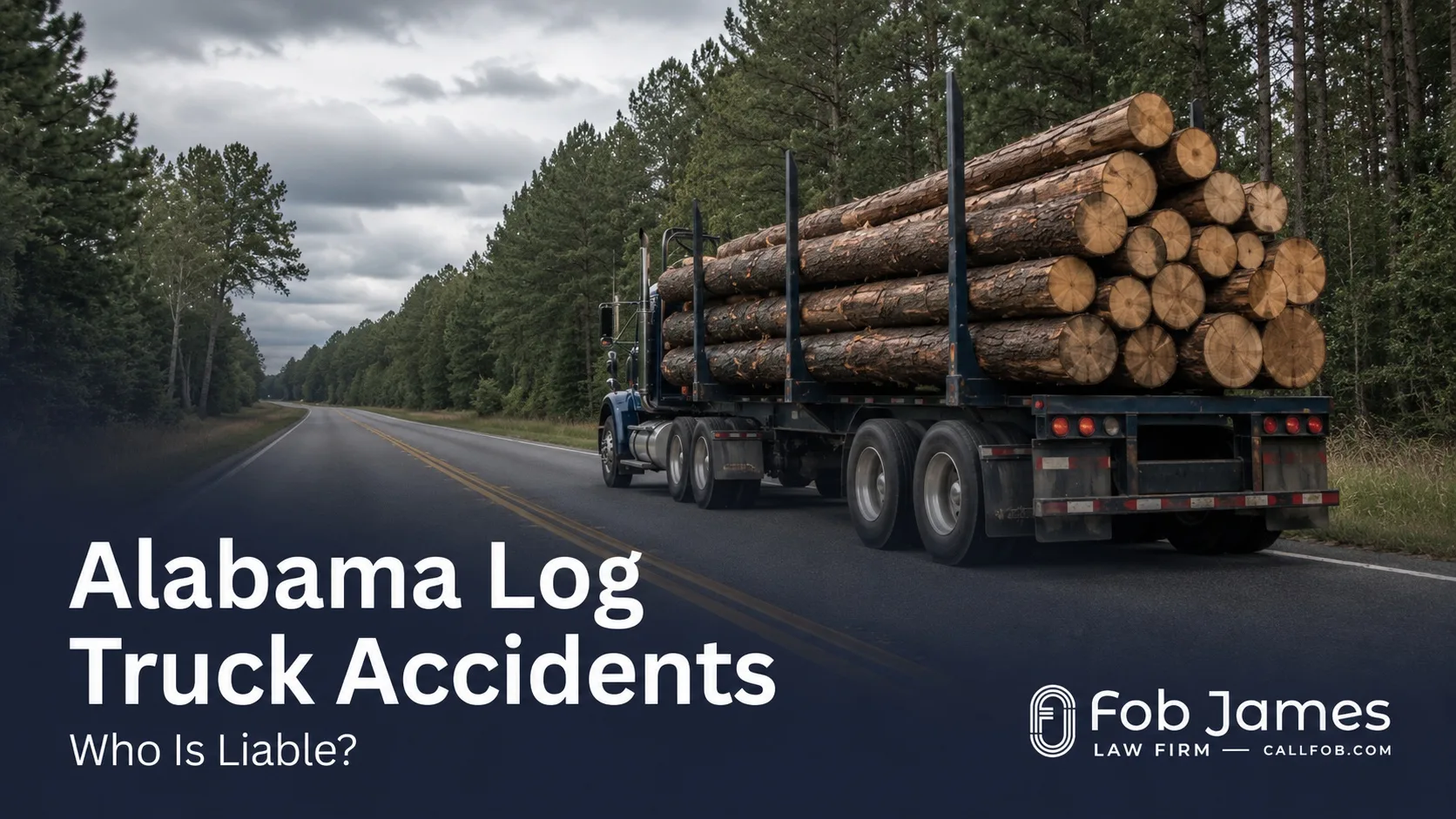
Alabama is one of the most heavily forested states in the country, with timberland covering roughly two-thirds of the state, and that timber moves on trucks. Log trucks are a daily presence on rural highways from Clanton to Camden, and they combine nearly every risk factor in trucking: extreme weights, shifting cylindrical cargo, slow entries onto fast two-lane roads, and loads that can spear through a windshield when securement fails.
The Alabama truck accident lawyers at Fob James Law Firm have recovered substantial settlements in logging truck cases, including $750,000 for a Barbour County log truck crash victim. Here’s why these wrecks happen and who pays when they do.
Why Log Trucks Are Among Alabama’s Most Dangerous Vehicles
The cargo wants to move. Logs are heavy cylinders stacked high. If stakes, bolsters, or binders fail, the load shifts in curves or spills entirely, and a shifted load flips the truck or sends timber across both lanes.
The roads are unforgiving. Timber hauls run on rural two-lane highways with no shoulders, blind hills, and unlit stretches. A log truck pulling out of an unpaved logging road takes a long time to reach highway speed, and traffic coming over a hill has seconds to react.
The overhang kills. Logs legally project beyond the trailer only within limits and with required flags and lights. Unmarked overhanging logs at dusk are nearly invisible, and rear-end collisions with them are catastrophically different from ordinary rear-enders: the logs come through the windshield.
The equipment runs hard. Logging is a thin-margin business, and trucks often run older, heavier, and rougher than freight fleets, with maintenance to match. Brake failures on loaded descents are a recurring Alabama story.
The Rules Log Haulers Must Follow
Commercial log trucks are subject to federal cargo securement standards, which set specific requirements for stakes, bunks, and tiedowns on logs, plus driver qualification, hours, and maintenance rules. Alabama adds its own weight and permitting framework for timber hauls. Violations of securement and marking rules are exactly the kind of evidence that turns a he-said-she-said wreck into a clear liability case, and they support punitive damages when the conduct was wanton, which matters enormously in Alabama wrongful death cases where punitive damages are the only recovery.
Who Is Liable in a Log Truck Crash?
Log hauling involves a chain: the timber owner, the logging crew that cut and loaded, the hauling company, and the driver, sometimes all one small operation, sometimes separate businesses. The driver and hauler answer for negligent driving; whoever loaded and secured the timber answers for securement failures; and equipment failures pull in maintenance and manufacturers. Many haulers are small operators carrying minimum coverage, so finding every liable party and policy is the difference between a capped recovery and a full one. Our guide to every party who can be sued after an Alabama truck accident maps the full chain, and our breakdown of improperly loaded truck crashes covers the securement claims in depth.
What Log Truck Cases Are Worth
These crashes cluster in the serious tiers: spinal injuries, brain trauma, and deaths are disproportionately common because of the weights and the rural head-on geometry. Value turns on injury severity, the securement and maintenance evidence, and the insurance actually available. See where your case likely falls in our Alabama truck accident settlement guide.
Frequently Asked Questions
Are logs allowed to extend past the back of a log truck?
Projecting loads are permitted only within limits and with proper marking: overhanging logs must be flagged, and at night marked with lights, so following drivers can see them. Unmarked or excessively projecting logs are a violation, and rear-end collisions with them are among the deadliest log truck crashes because the logs enter the passenger compartment.
Who is liable in an Alabama log truck accident?
Potentially several parties: the driver, the logging or hauling company, whoever loaded and secured the timber, and in some cases the landowner or mill arrangement behind the haul. Many log trucks are run by small operators with minimum insurance, so identifying every liable party and policy is critical to recovering full value.
What should I do after a crash with a log truck?
Get medical care, report the crash, and photograph the truck, the logs, the securement equipment, and any markings or flags before the scene is cleared. Then involve a lawyer immediately: securement evidence disappears when the load is hauled away, and the hauler’s insurer starts building its defense the same day.
Hit by a Log Truck in Alabama? We Know These Cases.
From Barbour County to the Black Belt, we’ve held timber haulers accountable. The Alabama truck accident attorneys at Fob James Law Firm investigate the load, the equipment, and the whole hauling chain, and you pay nothing unless we win. Call (205) 407-6009 or contact us online for a free case review.

Fob James, IV
Fob James obtained a B.S., in software engineering from Auburn University and then continued his education by getting his J.D. from Vanderbilt University School of Law. After working for a large national firm for several years, Fob found that his passion was fighting for individuals who have been seriously injured or wronged by others. Fob believes that the jury is the great equalizer to the power and influence that large corporations have in society. Many of Fob’s cases are high profile and have been featured in, among others: Bloomberg News, PlanAdvisor, AL.com, PlanSponsor, InsuranceJournal, and BusinessInsider. For his work in obtaining numerous multi-million dollar outcomes for his clients, Fob has been recognized by: National Trial Lawyers Top 100, SuperLawyers Rising Star (2020-2026), Birmingham Business Journal Who’s Who in Law (2023-2025), and TrustAnalytica – Top Personal Injury Lawyers in Alabama.