
 Alabama Accident News
Jefferson County, Alabama | September 5, 2026
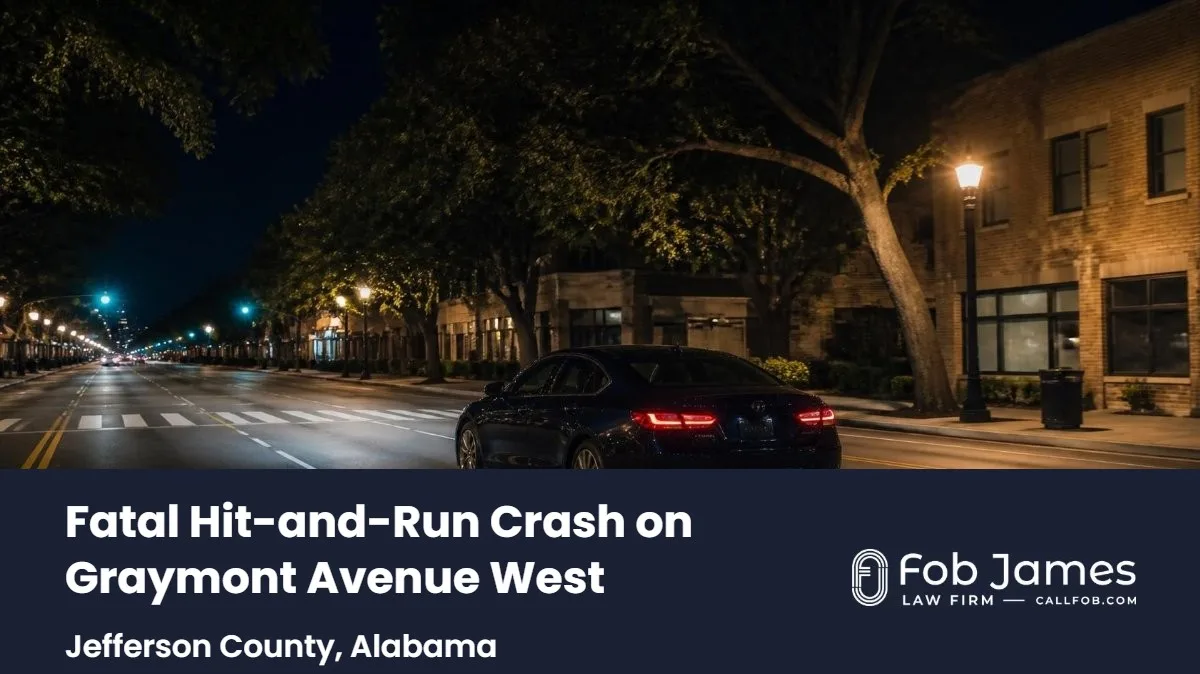
A 54-year-old Birmingham woman was struck by a vehicle on Graymont Avenue West on the night of Sunday, August 30, 2026. Emergency crews took her to UAB Hospital, where she was pronounced dead twenty-eight minutes later. The driver who hit her did not stop. Nearly a week later, the Birmingham Police Department has not announced an arrest, and the vehicle has not been publicly identified.
Our sympathies are with her family and with everyone who loved her. Losing someone suddenly is hard enough. Being told that the person responsible drove away, and that nobody yet knows who they were, adds a particular kind of weight that most families are not prepared to carry.
What Happened on Graymont Avenue West
According to the Jefferson County Coroner’s Office and reporting from WBRC, the woman was hit at 10:17 p.m. on Sunday, August 30, at Graymont Avenue West and 2nd Street West on Birmingham’s west side. She was transported to UAB Hospital and died there at 10:45 p.m.
The coroner’s office confirmed that the driver did not remain at the scene. The Birmingham Police Department is investigating, and the case was still described as developing as of this writing.
A great deal remains unreported, and we are not going to fill those gaps with assumptions. As of now, no public source has said which direction the vehicle was traveling, what kind of vehicle it was, how fast it was going, whether the woman was in a marked crosswalk, or whether any witnesses saw the impact itself. Those facts matter enormously to how this case would be evaluated, and none of them are known yet.
What is known is that a pedestrian is dead, and that the person who hit her made a decision afterward to leave.
Who May Be Liable
Hit-and-run cases have an obvious problem at the center of them: the most important defendant is missing. That does not mean there is no case. It means the case is built differently.
The driver who left the scene
Alabama law does not treat leaving as a gray area. Under Ala. Code § 32-10-1, a driver involved in a crash that injures or kills someone must stop immediately at or near the scene and remain there. Section 32-10-2 adds the duty to give identifying information and render reasonable assistance, including arranging transport to medical care when it is apparent that care is needed. Leaving is a separate wrong from whatever caused the collision, and it carries criminal exposure on its own.
It is also worth saying plainly: fleeing does not erase civil liability. It creates a second problem for the driver rather than solving the first one.
How unidentified drivers get identified
These vehicles are found more often than people expect, and usually through unglamorous work done quickly:
- Private security and doorbell video from homes and businesses along the corridor, which typically overwrites itself within seven to thirty days
- Municipal and traffic camera footage
- Physical evidence from the scene, including paint transfer, broken trim, glass, and headlight or mirror fragments that can identify a make and model
- Body shop and salvage yard reports of front-end or windshield damage in the days after
- Anonymous tips, which in Birmingham typically route through Crime Stoppers of Metro Alabama
The video point is the urgent one. Footage that would identify this vehicle may already be counting down toward being overwritten.
If the driver is never identified
This is where uninsured motorist coverage becomes the center of the case. Ala. Code § 32-7-23(a) requires that every automobile liability policy issued in Alabama include uninsured motorist coverage unless the named insured affirmatively rejects it. Standard Alabama UM policy language treats a hit-and-run vehicle whose operator cannot be identified the same way it treats a driver with no insurance at all.
That means a family may have coverage available through the deceased person’s own auto policy, and sometimes through policies held by resident relatives, even though she was walking rather than driving. Many families do not know this and never ask. It is one of the first things worth checking, and it is worth checking every policy in the household rather than just the obvious one. Our overview of uninsured motorist coverage in Alabama goes into how these claims work.
If the driver is identified
Then the analysis widens. If the person was driving for work at the time, or driving a vehicle owned by an employer, the employer may share liability. If the driver had been drinking at a licensed establishment beforehand, Alabama’s Dram Shop Act under Ala. Code § 6-5-71 can reach the seller who served them. Neither of those has been reported here. They are simply the questions that get asked once a name exists.
The honest weakness in this case
Alabama follows pure contributory negligence, a rule the Alabama Supreme Court reaffirmed in Golden v. McCurry, 392 So. 2d 815 (Ala. 1980). If a jury finds the injured person even slightly at fault, and that fault contributed to the injury, recovery is barred entirely. Alabama is one of a very small number of states that still works this way, and it makes pedestrian cases harder here than almost anywhere else.
An insurer defending this claim will build toward that rule. Alabama’s pedestrian statutes give it material to work with: § 32-5A-212 requires a pedestrian crossing outside a crosswalk to yield to vehicles, and § 32-5A-215 addresses walking along a roadway where a sidewalk is available. A 10:17 p.m. collision on an urban street is exactly the fact pattern that invites that argument.
The counterweight is that pedestrians are not fair game outside a crosswalk. Section 32-5A-211 gives pedestrians the right of way in crosswalks, and Alabama drivers owe a duty of reasonable care regardless of where a person is standing, including a duty to keep a proper lookout and to take reasonable steps to avoid someone they see or should see. A driver who was speeding, distracted, or impaired does not get to shift the whole loss onto the person they hit. And no version of these facts makes leaving acceptable.
One more point on language. When investigators say a pedestrian was “struck by” a vehicle, they are describing a physical sequence, not making a legal finding. It says who hit whom. It does not say who was at fault, and it should not be read that way in either direction.
Wrongful Death Rights Under Alabama Law
Alabama’s wrongful death statute, Ala. Code § 6-5-410, is unlike any other state’s, and families are routinely surprised by how it works.
Only the personal representative of the estate may file the claim. Not a spouse in their own name, not a child, not a parent, unless that person has been appointed personal representative through probate court. Getting that appointment is often the first practical step, and it takes time that families do not realize they are spending.
The damages are punitive only. This is the part that catches people off guard. An Alabama wrongful death verdict does not compensate the family for lost income, medical or funeral expenses, the loss of a mother’s companionship, or the family’s grief. Those categories, which form the core of a wrongful death case in nearly every other state, are simply not recoverable here. The jury’s question is narrower: how wrongful was the defendant’s conduct, and what amount is appropriate to punish it and deter others.
Any recovery passes to the heirs under Alabama’s intestacy rules rather than through the estate, which means it generally is not available to the deceased person’s creditors.
The deadline is two years, and it runs from the date of death rather than the date of the crash, under § 6-5-410(d). Here those are the same day, August 30, 2026, which puts the deadline at August 30, 2028. That is a hard limit. Alabama courts have treated it as a condition on the right itself rather than an ordinary statute of limitations, which means the usual arguments for extending a deadline generally do not apply.
If someone had survived this crash with injuries, their own personal injury claim would run on a separate two-year clock from the date of the crash under Ala. Code § 6-2-38(l).
How Alabama Wrongful Death Damages Are Assessed
Because the damages are punitive, the jury looks at the defendant’s conduct rather than the family’s loss. In practice, juries weigh how far the conduct departed from ordinary carefulness, whether it was a momentary lapse or a sustained choice, and whether anything about it suggests indifference to other people’s safety.
Leaving the scene is significant in that analysis. A driver who stops, calls 911, and stays has made a mistake. A driver who accelerates away from a person lying in the road has made a mistake and then made a decision about it. Alabama juries have historically not been indifferent to that distinction.
Notably, Alabama’s general cap on punitive damages does not apply here. Ala. Code § 6-11-21(j) expressly exempts wrongful death actions from the statutory limits that apply in other civil cases.
The practical ceiling in a hit-and-run case is usually not the jury, though. It is the available insurance. If the driver is never found, recovery comes through uninsured motorist limits, and those limits are whatever the household actually purchased. Alabama’s minimum liability requirement is low, and many people carry UM at that minimum without ever having thought about it. Identifying every applicable policy, and reading the stacking language in each one, frequently changes the arithmetic of a case like this more than anything that happens in a courtroom.
What Families Should Know
The most counterintuitive thing about a hit-and-run claim is that the insurance company on the other side is often your own. A UM claim is filed against the policy the family pays for, and families reasonably expect that relationship to be cooperative. It is a claim like any other, and it is evaluated by an adjuster whose job includes controlling what it costs.
A few things tend to come up early:
- Notice deadlines. Many UM policies require prompt notice of a hit-and-run and some require that the collision have been reported to law enforcement within a short window, often twenty-four hours. Here the Birmingham Police Department responded that night, which should satisfy that requirement, but the policy language is worth reading rather than assuming.
- Recorded statements. A request for one usually comes quickly, often while the family is still making funeral arrangements. Nothing requires giving one on the adjuster’s timeline.
- Early offers. An offer that arrives before the police investigation has resolved is priced on incomplete information by definition. If the driver is later identified, and particularly if that driver turns out to have been impaired or driving for an employer, the value of the case can change substantially.
- Blanket medical authorizations. Broad releases give access to an entire medical history rather than the records connected to this crash. Narrower authorizations are usually appropriate.
- Contributory negligence arguments. Expect questions designed to establish where she was standing and whether she was in a crosswalk. Under Golden, an admission on that point can end the claim outright, which is why these questions deserve care rather than a good-faith guess.
On the evidence side, two things are time-sensitive. The first is the official crash report, which the family is entitled to and which anchors everything that follows; we explain how to get one in our guide to obtaining an Alabama crash report, and you can also request a copy through our office at no charge. The second is video. Businesses and homes along Graymont Avenue West may have recorded the vehicle, and most of those systems overwrite on a loop measured in days or weeks. Once that footage is gone, it is gone.
Taking the First Step Toward Answers
“When a driver leaves someone in the road, the family is left with two questions at once: who did this, and what happens now. Those are different questions with different answers, and the family should not have to chase both of them alone while they are planning a funeral. The police work the first one. Our job is to make sure the second one does not get quietly foreclosed by a deadline nobody told them about or a policy nobody read.”
Fob James, IV
If your family has been affected by this crash, or by any pedestrian collision or hit-and-run in Jefferson County, we are glad to talk it through with no charge and no obligation. That conversation is worth having early, while video still exists and while the coverage questions are still open. Our wrongful death team and our Birmingham personal injury lawyers handle these cases throughout central Alabama.
Call 205-407-6009 to speak with someone at Fob James Personal Injury Lawyers.
Local Resources for Jefferson County Crash Victims and Families
- Birmingham Police Department — 205-254-1700
- Crime Stoppers of Metro Alabama (anonymous tip line, up to $5,000 reward) — 205-254-7777
- Jefferson County Coroner / Medical Examiner — 205-930-3603
- UAB Hospital — 205-934-3411
- Alabama Crime Victims Compensation Commission — 1-800-541-9388
If you saw anything on Graymont Avenue West on the night of August 30, or if you have camera footage from that area, the Crime Stoppers tip line takes information anonymously.

Fob James, IV
Fob James obtained a B.S., in software engineering from Auburn University and then continued his education by getting his J.D. from Vanderbilt University School of Law. After working for a large national firm for several years, Fob found that his passion was fighting for individuals who have been seriously injured or wronged by others. Fob believes that the jury is the great equalizer to the power and influence that large corporations have in society. Many of Fob’s cases are high profile and have been featured in, among others: Bloomberg News, PlanAdvisor, AL.com, PlanSponsor, National Law Review, and BusinessInsider. For his work in obtaining numerous multi-million dollar outcomes for his clients, Fob has been recognized by: National Trial Lawyers Top 100, SuperLawyers Rising Star (2020-2026), Birmingham Business Journal Who’s Who in Law (2023-2025), and TrustAnalytica – Top Personal Injury Lawyers in Alabama.