
 Alabama Accident News
Jefferson County, Alabama | September 17, 2026
A 56-year-old Birmingham man and his 22-year-old son were killed late Sunday night on Interstate 65 North in Birmingham after the younger man’s car broke down and the two ended up on foot in the travel lanes. According to the Jefferson County Coroner’s Office, the father was struck shortly before midnight and his son was struck roughly a minute later, between Finley Boulevard and 32nd Avenue North. Both were pronounced dead at the scene. Birmingham Police are investigating.
Our hearts are with this family. A father drove out in the middle of the night because his son was stranded, and neither of them came home. There is no version of that sentence that gets easier with rearranging. Nothing written below is meant to soften it. It is offered only for families who find themselves needing to understand what Alabama law allows them to do next.
What Happened on Interstate 65 North
The sequence began with a mechanical failure. According to family members who spoke with WBRC, the 22-year-old was driving home northbound on I-65 when an axle broke at the rear of his car. The wheel came off, traveled across the interstate, and struck the median. He called home. His father drove out to him.
When the father arrived, he saw the detached wheel sitting in the roadway. Understanding what a loose wheel does to traffic moving at interstate speed, he stepped out to drag it clear. The family says he judged that the road was empty, crossed roughly two lanes, and had nearly made it back when he was struck. His son was struck moments afterward.
The Jefferson County Coroner’s Office recorded the father as injured at 11:42 p.m. Sunday and the son about one minute later. Both men were pronounced dead at the scene at 12:05 a.m. Monday. The coroner’s office said the driver who struck them remained at the scene and called police.
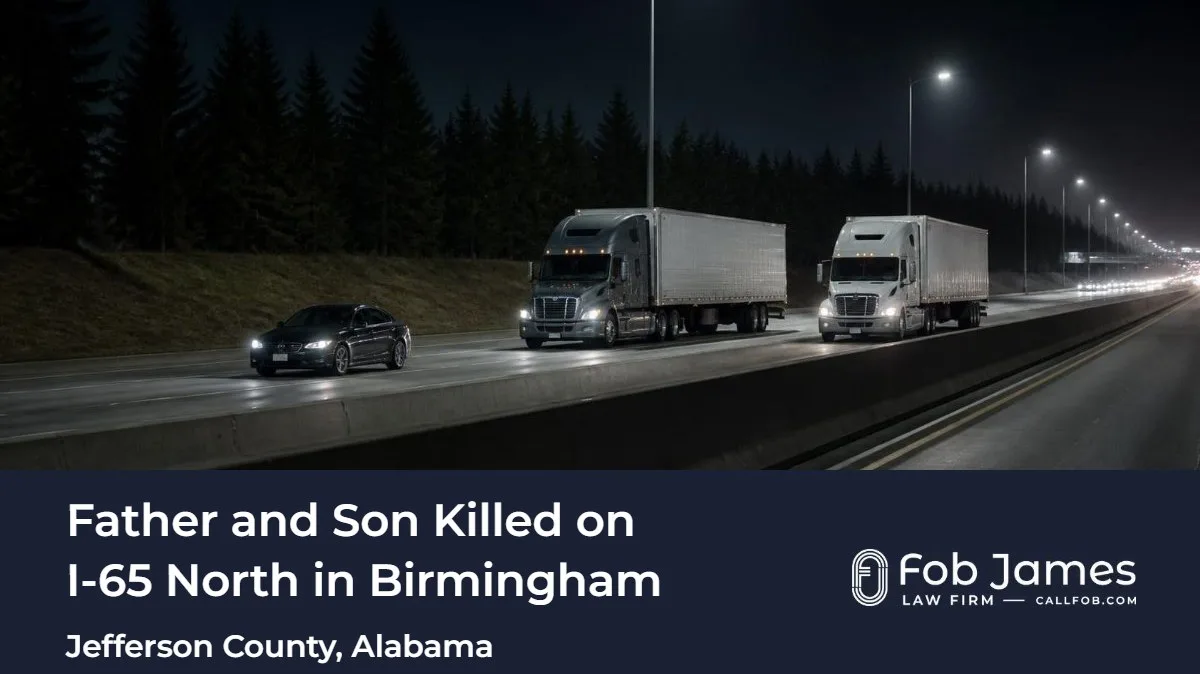
One material fact is in dispute, and we would rather name the conflict than paper over it. The account released through the coroner’s office and Birmingham Police describes the two men as struck by a vehicle, singular. The family’s account, given to WBRC, describes something considerably worse: a car that clipped the father first, followed by two tractor-trailers that came through afterward and struck both men. Those are not small variations on the same story. They point to different defendants, different insurance policies, and different bodies of law. Investigators have not publicly reconciled them, and until they do, neither will we.
Several other facts remain unreleased. Authorities have not described the striking vehicle or vehicles, identified any driver, stated a speed, or announced any determination of fault. What is confirmed is the location, the timing, the number of deaths, and that a disabled vehicle and roadway debris were part of the scene.
Who May Be Liable
A crash with this many moving parts rarely has a single answer. There are four directions this can go, and a family is entitled to see all of them laid out.
The driver or drivers who struck them. Every driver owes a duty to keep a proper lookout and to drive at a speed that allows them to stop within the distance they can actually see. At night, that second duty has a name: a driver who cannot stop within the range of their own headlights is, as a general matter, driving too fast for conditions. A disabled car on the shoulder, a detached wheel in the roadway, and people moving near the lanes are exactly the hazards that duty exists to address. Whether the driver saw them, when, and what they did next are the central questions.
A motor carrier, if the family’s account is confirmed. If tractor-trailers were involved, the analysis changes substantially. A commercial claim reaches past the driver to the carrier that employed him, and it opens evidence that does not exist in an ordinary car case: engine control module data, electronic logging device records, dashcam footage, the driver qualification file, and hours-of-service records that speak directly to fatigue on a late-Sunday-night run. Carriers also typically carry policy limits far above what a personal auto policy provides, which matters enormously when two people have died. Our overview of who can be sued after an Alabama truck accident walks through how those layers stack, and our truck accident attorneys handle these claims statewide.
Whoever is responsible for the wheel coming off. This is the possibility most families would never think to ask about. An axle does not ordinarily fail and shed a wheel at highway speed without a reason. Improperly torqued lug nuts after a tire service, a defective hub or bearing, a negligent repair, or a known component defect are all plausible explanations — and each one points to a defendant who is not a driver at all. If a shop or a manufacturer put that wheel in the roadway, that party may bear responsibility for everything that followed. Proving it requires the car, which is why preserving the vehicle before it goes to salvage is urgent rather than optional. Our defective product attorneys evaluate these claims.
Anyone who left the scene. If evidence later shows an additional vehicle contributed and departed, the analysis widens again.
A point of vocabulary matters here. When police or the Alabama Law Enforcement Agency say that one party “struck” another, they are describing the physical sequence of a collision. They are not assigning legal fault. A person can be struck and still bear responsibility, and a driver can do the striking and bear none. Insurance adjusters sometimes quote that language as though it settles the question. It does not.
The Contributory Negligence Problem, Stated Honestly
We are not going to pretend this is a simple case. Both men were on foot on an interstate at night, and that fact will be the centerpiece of the defense.
Alabama follows the common law rule of contributory negligence, reaffirmed in Golden v. McCurry, 392 So. 2d 815 (Ala. 1980). A person whose own negligence contributed to their injuries, even slightly, recovers nothing at all. Alabama is one of a small handful of states that still applies it. The defense does not have to prove the driver was mostly in the right. It only has to persuade a jury that the people who died were partly in the wrong.
That is the hard part. Here is the part that cuts the other way — and it is substantial.
Alabama law has long recognized that a person who acts to avert danger to others is judged differently from someone who wanders into traffic for no reason. A man who steps into a lane to remove a wheel that he did not put there, in order to keep it from destroying the next car that comes along, is not behaving carelessly. He is doing the thing the law generally wants people to do. The same principle applies with even more force to a son who moved toward a father who had just been hit. Whether those facts are framed as a sudden emergency, as a rescue, or simply as reasonable conduct under terrible circumstances, they are the difference between a case and no case, and they are established by evidence rather than by argument.
That is why the reconstruction matters so much here: sight distance, lighting, where the disabled car sat, whether its hazard lights were on, the position of the wheel, and what a reasonably attentive driver would have been able to see and do. Those questions are answerable. They just have to be answered before the evidence is gone.
Wrongful Death Rights Under Alabama Law
Alabama’s wrongful death statute, Ala. Code § 6-5-410, works differently from every other state’s, and the differences are not technicalities.
Only the personal representative of the deceased person’s estate may bring the claim. Not a spouse in their own name, not a parent, not a sibling, but the personal representative, appointed through the probate court. Where two people in one family have died, that means two estates and two appointments, and the person appointed for the father may or may not be the person appointed for the son. Families sometimes lose months discovering this. Opening an estate is usually straightforward, but it has to happen before a lawsuit can be filed.
The filing deadline runs two years from the date of death, not the date of the crash. Section 6-5-410(d) is explicit. Where death is immediate the two dates coincide, but where a person survives for a period before dying they do not, and the distinction can decide whether a case exists at all.
If a person survives a crash and brings a claim for their own injuries, the deadline is different again: two years from the date of the crash, under Ala. Code § 6-2-38(l).
How Alabama Wrongful Death Damages Are Assessed
This is where Alabama departs most sharply from what families expect, and it is worth stating plainly before anyone builds expectations on the wrong foundation.
In an Alabama wrongful death case, damages are punitive only. A jury is not asked to calculate the income the person would have earned, the medical bills incurred before death, the funeral costs, or the value of the companionship the family lost. Those categories, which form the core of a wrongful death verdict almost everywhere else, are not recoverable in Alabama.
Instead, the jury assesses the wrongfulness of the defendant’s conduct and sets an amount meant to punish it and deter others. The measure is the quality of the conduct that caused the death, not the financial loss to the survivors.
Two practical consequences follow. A case involving a young man at the start of his working life and a case involving an established earner are valued by the same standard, because earnings are not part of the calculation. And evidence about how the at-fault party behaved carries far more weight than it would elsewhere. Speed, impairment, phone use, hours behind the wheel, a carrier’s knowledge of a fatigued driver, a shop’s decision to skip a torque check: in Alabama that is not background. It is the damages case.
Any recovery passes to the heirs under Alabama’s intestacy statutes and is not subject to the claims of the estate’s creditors.
What Families Should Know
In the days after a fatal crash, families are usually contacted by at least one insurance company, often several. Those calls are not neutral, and it helps to know what they are for.
The recorded statement. An adjuster will often ask for one within the first week, framed as routine paperwork. In a contributory negligence state, a recorded statement is an opportunity to capture one sentence that can later be characterized as an admission that a family member should not have been in the roadway. There is no legal obligation to give a statement to another party’s insurer.
The early offer. A settlement offer that arrives before the investigation is finished is not generosity. It is a bet that the family does not yet know what the claim is worth, or who all the defendants are. A release signed in exchange closes the matter permanently, including against parties nobody has identified yet. In a case where a motor carrier or a repair shop may turn out to be responsible, signing early can extinguish the most valuable part of the claim before anyone knows it existed.
Your own coverage may matter more than you expect. If the at-fault driver carried Alabama’s minimum liability limits, those limits can be exhausted almost immediately when two people have died. Uninsured and underinsured motorist coverage on the family’s own policies, and sometimes on a resident relative’s policy, often becomes the meaningful source of recovery. UM and UIM claims carry their own notice requirements and their own deadlines, and missing them forfeits the coverage.
Evidence disappears fast, and here it disappears faster than usual. The disabled car is the physical proof of why the wheel came off, and salvage yards crush vehicles on a schedule that has nothing to do with anyone’s legal deadline. Event data recorders get overwritten. A commercial carrier’s hours-of-service records and ECM data are subject to retention periods measured in months, and some of it in days. Interstate and business camera footage is typically recycled within weeks. A preservation letter sent early is frequently the difference between a provable case and a plausible theory.
Families can request the official crash report once it is completed. Our guide on how to get your Alabama crash report walks through the process.
Taking the First Step Toward Answers
“When a family calls us after something like this, they are almost never asking about money,” says attorney Fob James IV. “They want to know what actually happened, and whether the people they love were failed by someone. In this case there are two very different accounts of how many vehicles were involved, and a broken axle nobody has explained. Those are answerable questions. Somebody just has to do the work while the evidence still exists. Our job is to get the facts first and let the family decide what to do with them.”
If your family lost someone in this crash, you are entitled to an independent look at the evidence before you speak to anyone’s insurance company. Our Birmingham pedestrian accident attorneys, car accident lawyers, and Birmingham personal injury team handle these cases throughout Jefferson County, including Homewood, Hoover, and Trussville.
Consultations are free, and we are paid only if we recover for you. Call 205-407-6009. If it is easier to have someone come to you, we will.
Local Resources for Jefferson County Crash Victims and Families
- Jefferson County Coroner / Medical Examiner: 205-930-3603
- Birmingham Police Department (non-emergency): 205-328-9311
- Birmingham Police Department (headquarters): 205-254-1700
- Jefferson County Sheriff’s Office: 205-325-5700
- UAB Hospital: 205-934-3411
- Alabama Crime Victims Compensation Commission: 1-800-541-9388
This post is based on reporting by WBRC FOX6 News and ABC 33/40, and on information attributed to the Jefferson County Coroner’s Office and the Birmingham Police Department. Official statements describe the men as having been struck by a single vehicle whose driver remained at the scene; family members interviewed by WBRC described a passenger vehicle followed by two tractor-trailers. We have presented both accounts rather than choosing between them. Birmingham Police have not released a full account of the collision, and facts reported during an ongoing investigation frequently change. We have deliberately not named the men who died. Nothing here is legal advice, and nothing here is a statement of fault by any party.

Fob James, IV
Fob James obtained a B.S., in software engineering from Auburn University and then continued his education by getting his J.D. from Vanderbilt University School of Law. After working for a large national firm for several years, Fob found that his passion was fighting for individuals who have been seriously injured or wronged by others. Fob believes that the jury is the great equalizer to the power and influence that large corporations have in society. Many of Fob’s cases are high profile and have been featured in, among others: Bloomberg News, PlanAdvisor, AL.com, PlanSponsor, InsuranceJournal, and BusinessInsider. For his work in obtaining numerous multi-million dollar outcomes for his clients, Fob has been recognized by: National Trial Lawyers Top 100, SuperLawyers Rising Star (2020-2026), Birmingham Business Journal Who’s Who in Law (2023-2025), and TrustAnalytica – Top Personal Injury Lawyers in Alabama.