
 Alabama Accident News
Cullman County, Alabama | October 7, 2026
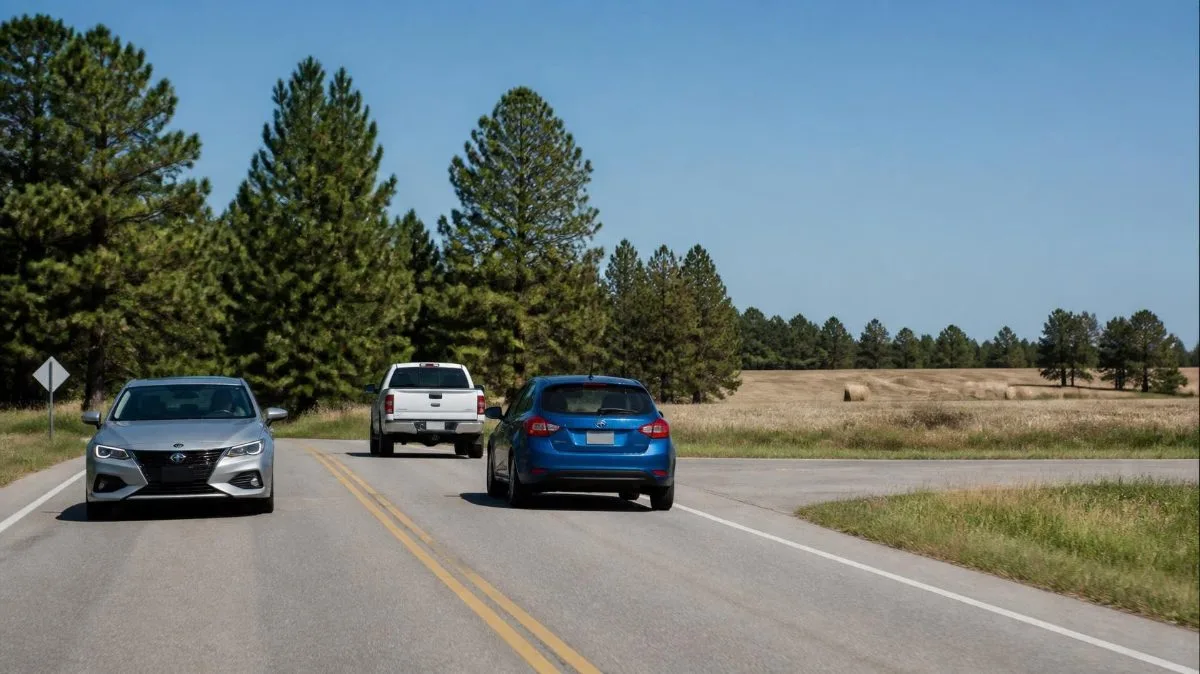
A 73-year-old Cullman woman died on Thursday, October 1, 2026, after her car was struck by two other vehicles at the intersection of Alabama 69 and Cullman County Road 747, roughly nine miles east of Vinemont. According to the Alabama Law Enforcement Agency, the collision happened at about 1 p.m. She was pronounced dead at the scene.
Her 2015 Hyundai Sonata was hit by a 2012 Ford Focus and then by a 2003 Ford F-250 pickup truck. Troopers with ALEA’s Highway Patrol Division are still investigating, and no determination of fault has been announced.
Our condolences go to this woman’s family. Losing someone in the middle of an ordinary afternoon is a shock, and the questions that follow can feel impossible to sort out while you are still grieving.
What Happened on Alabama 69
According to ALEA, as reported by WAFF, The Cullman Tribune and The Cullman Times, the sequence was this: the Focus struck the Sonata, and the F-250 then struck the Sonata. The Focus was driven by a 39-year-old Cullman woman and the F-250 by a 23-year-old man from Baileyton. The reports we reviewed do not say whether either of them was hurt. ALEA reported that the Sonata’s driver was not wearing a seat belt.
Several things that matter have not been made public: which direction each vehicle was traveling, whether the Sonata was entering Alabama 69 from the county road, crossing, turning or stopped, who had the right of way, whether a sign or signal controlled the intersection, how much time passed between the first impact and the second, and whether anyone has been cited. Until ALEA’s report is complete, any account that fills in those gaps is a guess.
One phrase deserves care. When ALEA says one vehicle struck another, it is describing the physical order of the impacts. It is not a finding of legal fault. A driver whose car was hit first can still have contributed to the crash, and a driver who hit second may have had no real chance to avoid it. Fault is decided by evidence, not by the order of collisions.
Who May Be Liable
With three vehicles and an intersection, more than one person may share responsibility, and the facts that would settle it have not been released. These are the questions a careful investigation would ask.
The driver of the Focus. If the Focus driver failed to yield, ran a sign or signal, was speeding, or was distracted, that conduct would explain the first impact. Every Alabama driver owes a duty to keep a proper lookout and drive with reasonable care.
The driver of the F-250. The pickup struck the Sonata after it had already been hit. That raises its own questions: how fast the truck was going, how closely it was following, whether the driver was paying attention, whether the truck could have stopped or steered clear, and whether its brakes and tires were in working order. A heavy-duty pickup needs more distance to stop than a passenger car.
An employer or vehicle owner. If either the Focus or the F-250 was being used for work, or belonged to someone other than the person driving it, the employer or owner may share responsibility. News reports do not answer that. Registration records, insurance information and the vehicles themselves can.
The Sonata’s driver. We raise this because the defense will. Alabama follows contributory negligence, a common-law rule applied in cases such as Golden v. McCurry, 392 So. 2d 815 (Ala. 1980), under which a person found even slightly at fault can be barred from recovering anything. Nothing released so far suggests the Sonata’s driver did anything wrong. But in an intersection crash, the layout, the sight lines and the signage decide that question, and the answer has to come from evidence rather than assumption.
There is also a coverage question. Three vehicles can mean three separate liability policies, plus the Sonata’s own coverage, including any uninsured or underinsured motorist coverage. The order of the impacts can affect which insurer owes what, and each carrier has a reason to point at another.
Wrongful Death Rights Under Alabama Law
Under Ala. Code § 6-5-410, a wrongful death claim is brought by the personal representative of the person who died, for the benefit of the family members who would inherit under Alabama law. That usually means an estate must be opened in probate court and a personal representative appointed before a case can be filed. Families who have not started that process should not wait on it.
The deadline is two years from the date of death, not the date of the crash. Under § 6-5-410(d), the clock here runs from October 1, 2026, since she died at the scene. Any injury claim by another person hurt in the crash falls under Ala. Code § 6-2-38(l) and runs two years from the crash date. Evidence disappears much faster than a deadline arrives, so waiting for the deadline to get close is a mistake.
For more on how these claims work, see our page on Alabama wrongful death claims.
How Alabama Wrongful Death Damages Are Assessed
Alabama is unusual. Its wrongful death statute allows punitive damages only. The claim is not built on lost income, funeral costs or the family’s grief, as it would be in most states. Instead, a jury is asked how culpable the defendant’s conduct was, and it sets a figure meant to punish and deter.
Ordinary inattention sits at one end of that range. Speed, impairment, phone use or a deliberate traffic violation sit at the other. The gap between a momentary lapse and a conscious disregard for other people’s safety is, in practical terms, the gap between a modest verdict and a very large one. Families often find this hard to hear. The age, health and work history of the person who died do not drive the number the way they would elsewhere. What the other driver did does.
Because everything turns on proving conduct, evidence preservation matters. In a three-vehicle crash that means the event data recorder in each vehicle, phone records, scene photographs, the layout and signage at the intersection, any nearby surveillance or dash camera video, 911 recordings, and the vehicles themselves, before they are repaired, sold or salvaged.
What Families Should Know Before They Talk to an Insurer
ALEA reported that the Sonata’s driver was not using a seat belt. An adjuster may bring that up. Under Ala. Code § 32-5B-7, failure to wear a seat belt is not admissible as contributory negligence and does not limit an insurer’s liability. It is a fact in the report, but it is not a defense to the other drivers’ conduct.
With several vehicles involved, expect calls from more than one insurance company, often within days. Adjusters are friendly and prompt, and they are working for the company, not for the family. A request for a recorded statement, a broad medical release or an early settlement offer deserves a pause. You are allowed to say you need time. Once a statement is on tape or a release is signed, it is very hard to take back.
A crash report will eventually be available, and it is worth requesting. Our guide to the Alabama crash report explains how to get it and what it does and does not tell you.
Taking the First Step Toward Answers
"When someone dies in a collision that involved more than one vehicle, families are often told very little and pulled in several directions at once," says Fob James, IV. "You do not have to sort that out alone, and you do not have to decide anything quickly. You are entitled to a clear picture of what happened and what Alabama law allows before anyone asks you to sign anything."
If your family lost someone in this crash, or in any collision in Cullman County, you can talk it through with a lawyer before you decide anything. There is no cost for the conversation and no obligation that follows it. Call 205-407-6009.
Our firm handles Alabama wrongful death claims and car accident cases for families in Cullman County and across north central Alabama, and throughout the Birmingham metro.
Local Resources for Cullman County Crash Victims and Families
- Cullman County Coroner — 256-347-5466
- Cullman County Sheriff’s Office — 256-734-0342
- Cullman Regional Medical Center — 256-737-2000
- Alabama Crime Victims Compensation Commission — 1-800-541-9388
ALEA’s Highway Patrol Division is the investigating agency for this crash, and crash reports are requested through ALEA’s records process rather than from the county.

Fob James, IV
Fob James obtained a B.S., in software engineering from Auburn University and then continued his education by getting his J.D. from Vanderbilt University School of Law. After working for a large national firm for several years, Fob found that his passion was fighting for individuals who have been seriously injured or wronged by others. Fob believes that the jury is the great equalizer to the power and influence that large corporations have in society. Many of Fob’s cases are high profile and have been featured in, among others: Bloomberg News, PlanAdvisor, AL.com, PlanSponsor, InsuranceJournal, and BusinessInsider. For his work in obtaining numerous multi-million dollar outcomes for his clients, Fob has been recognized by: National Trial Lawyers Top 100, SuperLawyers Rising Star (2020-2026), Birmingham Business Journal Who’s Who in Law (2023-2025), and TrustAnalytica – Top Personal Injury Lawyers in Alabama.