
 Alabama Accident News
Escambia County, Alabama | August 14, 2026
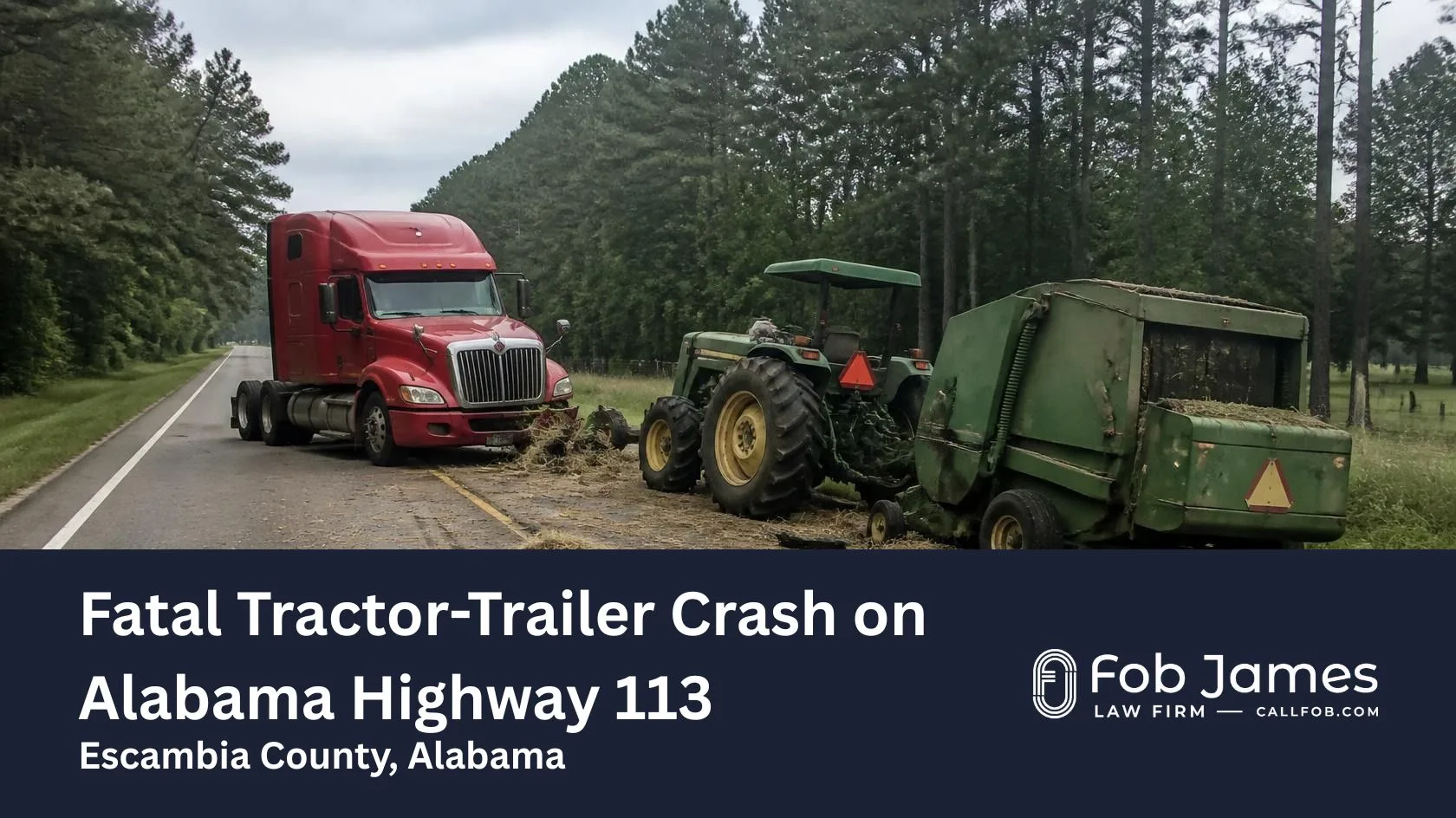
A 72-year-old Flomaton man was killed on the afternoon of Thursday, August 6, 2026, when the farm tractor he was driving was struck from behind by a semi-truck on Alabama Highway 113 in Escambia County. He was towing a hay baler at the time. State troopers pronounced him dead at the scene. The semi-truck’s driver, a 43-year-old man from Quincy, Florida, was injured and taken to D.W. McMillan Memorial Hospital in Brewton.
Our sympathies are with his family. In farming communities across south Alabama, moving equipment down a public highway is simply part of the working day, and a rear-end collision with a loaded tractor-trailer is a catastrophically one-sided event.
What Happened on Alabama 113
The Alabama Law Enforcement Agency reported that the crash occurred at approximately 1:50 p.m. on August 6, 2026, on Alabama 113 near the 11 mile marker, roughly 11 miles north of the Flomaton city limits in Escambia County.
According to ALEA, the man was operating a 1977 John Deere 4430 tractor that was towing a hay baler when it was hit from behind by a 2014 Kenworth semi-truck. He was pronounced deceased at the scene. The semi-truck’s driver was injured and transported to D.W. McMillan Memorial Hospital in Brewton for treatment. ALEA’s Highway Patrol Division continues to investigate, and no cause has been publicly announced.
Alabama 113 is a rural two-lane highway running north from Flomaton through farm and timber country. It carries agricultural equipment and log trucks alongside through traffic, and the speed differential between a working tractor and a highway-speed tractor-trailer on that kind of road is enormous. A loaded semi traveling at highway speed needs a great deal more distance to stop than most drivers appreciate, and that distance grows dramatically as speed increases.
Who May Be Liable
As always, a caution on terminology. ALEA’s statement that the tractor “was hit from behind by” the semi-truck describes the physical sequence of impact. It is not a legal finding of fault. That determination comes later and under a different standard.
That said, a rear-end collision involving a commercial motor vehicle opens up a substantially wider field of potential defendants than an ordinary two-car crash. A truck accident lawyer would be examining several layers at once.
The driver. Rear-end collisions typically raise questions of following distance, speed for conditions, attention, and perception-reaction time. A driver approaching a slow-moving vehicle in daylight on an open rural highway generally has substantial advance visibility, which makes the question of why the truck did not slow or move over a central one.
The motor carrier. The company that employed the driver or contracted for the load can be liable both for the driver’s conduct and for its own failures in hiring, training, supervision, and dispatch. Because the driver was from Florida and the crash occurred in Alabama, this very likely involves interstate commerce, which brings the Federal Motor Carrier Safety Regulations into play. Hours-of-service limits under 49 C.F.R. Part 395 exist precisely because fatigue degrades reaction time, and a driver pressured by an unrealistic delivery schedule is a well-documented cause of rear-end truck crashes.
Maintenance and equipment. Brake condition on a tractor-trailer is a recurring factor in rear-end crashes, and responsibility for maintenance may rest with the carrier, a separate maintenance contractor, or the trailer’s owner if the tractor and trailer belong to different entities.
The evidence that disappears fastest. Modern trucks record speed, braking, throttle, and following distance in the engine control module. Electronic logging devices record hours worked. Dispatch records, bills of lading, driver qualification files, and drug and alcohol testing records all exist immediately after a crash and are subject to routine retention limits that can be measured in months. A written spoliation letter demanding preservation of that material is one of the most time-sensitive steps in any truck case, and it is frequently the difference between proving a case and guessing at it.
Our firm has written in more detail about the full range of parties who can be held responsible after an Alabama truck accident, which is often considerably broader than families assume.
The weakness a family should hear about honestly. Alabama requires that farm tractors and other vehicles with a maximum speed of 25 miles per hour display a reflective slow-moving vehicle emblem when operated on a public highway, under Ala. Code § 32-5-246. Expect the carrier’s insurer to investigate hard whether the tractor and the hay baler carried a compliant, visible SMV emblem and adequate lighting, and to argue that any deficiency contributed to the crash.
That argument carries unusual weight in Alabama, because this state still applies pure contributory negligence. Under Golden v. McCurry, 392 So. 2d 815 (Ala. 1980), a plaintiff whose own negligence contributed to the injury in any degree is barred from recovering anything at all. There is no reduction by percentage. A defense that would shave a recovery by fifteen percent in most states can eliminate it entirely here. That is precisely why the condition and visibility of the tractor’s emblem and lighting need to be documented and photographed by someone working for the family, promptly, before the equipment is repaired, moved, or scrapped.
Wrongful Death Rights Under Alabama Law
Alabama’s wrongful death statute, Ala. Code § 6-5-410, works differently from the wrongful death law of every other state, and the differences matter enormously in practice.
The claim is brought by the personal representative of the deceased person’s estate, not by relatives in their own names. Any recovery passes outside the estate directly to the heirs under Alabama’s intestacy statute, which also means it is generally beyond the reach of the deceased person’s creditors. A will does not control how it is divided.
The filing deadline is two years from the date of death under § 6-5-410(d), rather than from the date of the crash. Here those dates are the same, because he died at the scene. In cases where someone survives in a hospital before passing, they are not, and families have lost otherwise strong cases by calculating from the wrong date. The injured truck driver’s own claim, meanwhile, would run under Ala. Code § 6-2-38(l), two years from the crash date.
How Alabama Wrongful Death Damages Are Assessed
Alabama stands alone in how it measures wrongful death damages: they are punitive only. There is no award for lost future earnings, no award for funeral and burial expenses, and no award for the family’s grief or lost companionship. Those compensatory categories, which form the backbone of a wrongful death case in nearly every other state, are unavailable here.
What the jury evaluates instead is the quality of the defendant’s conduct. The question is how wrongful the behavior was and what amount is necessary to punish it and deter others from doing the same.
In a commercial trucking case, this framework often works in a family’s favor. The age or earning history of the person who died does not cap the case. Evidence about the carrier does drive it: hours-of-service violations, a driver hired despite a poor safety record, deferred brake maintenance, falsified logs, or a dispatcher pushing an impossible schedule. Corporate conduct of that kind supports a substantially larger verdict than a moment of ordinary inattention, which is another reason the carrier’s internal records matter so much and why they must be preserved before anyone has a chance to cull them.
What Families Should Know
Trucking companies do not wait. Many dispatch a rapid response team to a fatal crash scene within hours, sometimes before the roadway has reopened, to photograph, measure, and interview while the evidence is fresh and the family is still absorbing the news. That is an entirely lawful and standard practice, and it means the carrier’s version of events begins taking shape long before a grieving family has thought about a lawyer.
The recorded statement. An adjuster may call within days sounding sympathetic and helpful. In a contributory negligence state, a single offhand remark about the tractor’s lights, its emblem, or where it was in the lane can be enough to build a complete defense. Nobody is required to give a recorded statement to another party’s insurer.
The early offer. A quick offer covering funeral costs can feel like a kindness at a terrible moment. It is made before anyone outside the carrier has seen the engine control module data or the driver’s logs, and accepting it releases every claim permanently, including claims against parties nobody has identified yet.
The multiple-policy problem. Interstate carriers commonly carry layered coverage: a primary policy, excess or umbrella layers above it, and sometimes separate policies for the trailer’s owner or a broker. Settling with the primary insurer early can foreclose access to the layers above it. Understanding the full coverage picture before signing anything is essential.
Preserve the equipment. Do not authorize repair, salvage, or scrapping of the tractor or the hay baler. Both are physical evidence, and in this case they are the specific evidence that answers the emblem and lighting defense. Photograph everything, including the reflective devices, before anything is moved.
Practical steps: request the official Alabama crash report; write down the names of anyone who stopped at the scene or arrived early; note any nearby business or residence that might have exterior cameras facing the highway; and review every insurance policy in the household, including farm and umbrella policies, for uninsured and underinsured motorist coverage.
Taking the First Step Toward Answers
“Trucking cases are not car cases with a bigger vehicle,” says Fob James, IV of Fob James Law Firm. “There is a federal regulatory layer, there are corporate records that tell you what really happened, and there is a very short window before some of those records are gone for good. When a family calls us early, we can send a preservation letter that same day. When they call a year later, we are often working with whatever the company decided to keep. That timing difference decides cases.”
If your family lost someone in this crash, or if you were injured in it, you can talk with our firm at no cost and with no obligation. We represent families throughout Alabama in serious injury and wrongful death matters on a contingency fee basis, meaning no fee unless we recover for you. Call 205-407-6009.
Even a short conversation about deadlines and evidence preservation costs nothing and can protect options that quietly close on their own.
Local Resources for Escambia County Crash Victims and Families
- Escambia County Coroner — 251-867-3607. For the death certificate, examination findings, and release of a loved one.
- Escambia County Sheriff’s Office — 251-809-0741. Non-emergency line for county incidents and records.
- D.W. McMillan Memorial Hospital, Brewton — 251-867-8061. Where the injured driver in this crash was taken.
- UAB Hospital, Birmingham — 205-934-3411. Level I trauma center for the most severe injuries statewide.
- Alabama Crime Victims Compensation Commission — 1-800-541-9388. May assist with funeral and medical costs where a crash involved criminal conduct such as impaired driving.
Fob James Law Firm handles commercial trucking and wrongful death cases across Alabama. Call 205-407-6009 for a free consultation.

Fob James, IV
Fob James obtained a B.S., in software engineering from Auburn University and then continued his education by getting his J.D. from Vanderbilt University School of Law. After working for a large national firm for several years, Fob found that his passion was fighting for individuals who have been seriously injured or wronged by others. Fob believes that the jury is the great equalizer to the power and influence that large corporations have in society. Many of Fob’s cases are high profile and have been featured in, among others: Bloomberg News, PlanAdvisor, AL.com, PlanSponsor, InsuranceJournal, and BusinessInsider. For his work in obtaining numerous multi-million dollar outcomes for his clients, Fob has been recognized by: National Trial Lawyers Top 100, SuperLawyers Rising Star (2020-2026), Birmingham Business Journal Who’s Who in Law (2023-2025), and TrustAnalytica – Top Personal Injury Lawyers in Alabama.