
 Alabama Accident News
Tuscaloosa County, Alabama | September 21, 2026
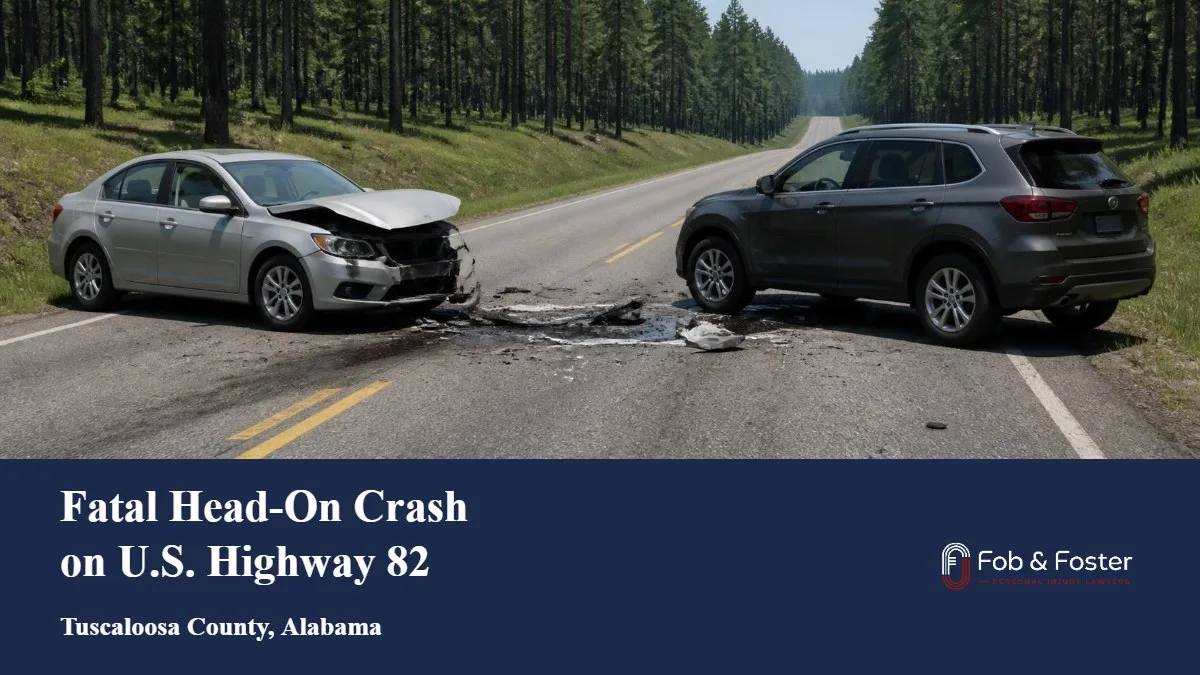
A late-night collision on U.S. Highway 82 east of Tuscaloosa has left a 24-year-old woman from Valrico, Florida dead and a 39-year-old Northport man hospitalized. According to the Alabama Law Enforcement Agency, two vehicles met head-on near the 59 mile marker at about 10:45 p.m. on Wednesday, September 16, 2026, roughly five miles east of the Tuscaloosa city limits. The woman was pronounced dead at the scene. The driver of the pickup was taken to DCH Regional Medical Center in Tuscaloosa for treatment.
Our sympathies are with the young woman’s family and with everyone shaken by what happened on that stretch of highway. Nothing in this post is meant to add to their grief. We write these summaries because families in this position are usually asked to make decisions — about insurance, about medical bills, about who to talk to — long before anyone has finished investigating. Understanding how Alabama law treats a crash like this one is the difference between making those decisions with information and making them under pressure.
What Happened on U.S. Highway 82
ALEA’s Highway Patrol Division reported that a 2026 Kia K4 sedan and a 2013 Ford F-150 pickup collided head-on. The sedan’s driver, a 24-year-old woman from Valrico, Florida, died at the scene. The pickup’s driver, a 39-year-old man from Northport, was injured and transported to DCH Regional Medical Center in Tuscaloosa. Troopers said the investigation remains open and released nothing further.
That last detail matters more than it looks. As of this writing, ALEA has not said which vehicle left its lane, what the roadway configuration was at that point, whether weather or visibility contributed, or whether impairment, fatigue, or distraction was involved. A head-on collision tells you that two vehicles which should have been separated by a painted line were not. It does not, on its own, tell anyone why, and the why is the entire case.
It is worth understanding how troopers write these reports, too. When ALEA says one vehicle “struck” another, it is describing the physical sequence of the collision. It is not assigning legal fault. Those are separate questions, answered by different people under different standards, and an insurance adjuster who quotes the trooper’s wording back to a family as though it settles the matter is doing something other than explaining the law. An Alabama crash report is where an investigation starts, not where it ends.
Who May Be Liable
In a two-vehicle head-on collision, liability almost always turns on one question: which vehicle crossed the center line, and what caused it to. Answering that credibly takes considerably more than the narrative section of a crash report. Depending on what the evidence shows, responsibility in a crash of this kind can rest with any of the following:
- The driver who left the travel lane. This is the obvious candidate and often the correct one. Crossing the center line is a departure from the ordinary standard of care, and if that departure caused the collision, the driver who made it, or that driver’s estate, can be liable.
- A vehicle or component manufacturer. A sudden steering, brake, tire, or throttle failure can put a car into oncoming traffic with no driver error at all. This is not a theory to reach for casually, but it is a real one, and it is only provable if the vehicles are preserved before the salvage yard crushes them. A defective product claim lives or dies on physical evidence.
- A government entity responsible for the roadway. Rutting, standing water from failed drainage, faded or missing center-line markings, or an unsafe shoulder drop-off can all contribute to a lane departure. Claims against public entities carry their own notice requirements and much shorter deadlines than ordinary negligence claims.
- An unidentified third vehicle. A driver forced across the center line by someone who never stopped, a so-called phantom vehicle, may not be at fault at all. These situations are usually handled through uninsured motorist coverage, which has its own notice conditions.
- An employer. If either driver was working at the time, whether making a delivery, driving a company truck, or running an errand for a business, the employer may be liable for the employee’s negligence and will typically have substantially more insurance coverage than an individual.
- A bar or restaurant. If impairment turns out to be involved and alcohol was served to someone visibly intoxicated, Alabama’s Dram Shop Act, Ala. Code § 6-5-71, can extend liability to the establishment that served them.
There is a practical point buried in the vehicle descriptions here that deserves attention. A 2026 Kia K4 carries an event data recorder and a suite of driver-assistance sensors that log speed, braking, steering angle, throttle position, seat belt status, and in many configurations lane-departure and forward-collision warnings in the seconds before impact. The 2013 F-150 has an event data recorder as well, though a less sophisticated one. That data is the closest thing to an objective witness a head-on crash produces, and it is routinely lost, because vehicles get released to salvage, modules get scrapped, and nobody sent a preservation letter in time. If your family is involved in a collision like this, getting a lawyer to send spoliation notices to every party holding a vehicle is among the most time-sensitive things that can be done.
We should be candid about one thing in this particular crash, because it would be dishonest to write around it. ALEA has not said which driver crossed the center line. If the investigation concludes that the woman who died crossed into the pickup’s lane, her estate’s claim becomes very difficult under Alabama law for reasons explained below, and the injured Northport driver becomes the one with a claim. If the pickup crossed, the reverse is true. Anyone telling a family which way this will come out before the reconstruction is finished is guessing.
Wrongful Death Rights Under Alabama Law
Alabama’s wrongful death statute, Ala. Code § 6-5-410, is unlike the wrongful death law of any other state, and families are frequently blindsided by how it works.
The claim belongs to the personal representative of the decedent’s estate, not to family members individually. A parent, spouse, or child cannot file in their own name. Someone must first be appointed personal representative through the probate court in the county where the decedent resided, and that appointment is a prerequisite to filing, not a formality to be handled later.
The deadline is two years from the date of death under § 6-5-410(d), which is not necessarily two years from the date of the crash. Where someone is injured in a collision and dies weeks or months afterward, the clock runs from the death. Where death is instantaneous, as it was here, the two dates are the same. This distinction has cost families their claims, and it is worth being precise about.
One feature of the statute works in a family’s favor: any recovery passes directly to the decedent’s heirs under Alabama’s laws of intestate succession. It does not become an asset of the estate, and it is not reachable by the decedent’s creditors. Medical providers and other creditors cannot claim against a wrongful death recovery.
How Alabama Wrongful Death Damages Are Assessed
This is where Alabama departs most sharply from what families expect, and it is worth stating plainly: damages in an Alabama wrongful death case are punitive only. There are no compensatory damages. None.
A jury in an Alabama wrongful death case is not permitted to award anything for the family’s grief, for the loss of a daughter’s companionship, for funeral expenses, for the income she would have earned over a lifetime, or for the medical bills incurred before she died. Those categories, which form the core of a wrongful death verdict nearly everywhere else in the country, are simply unavailable here.
Instead, the jury is asked to measure the defendant’s culpability, how wrongful the conduct was, and to set an amount that punishes it and deters others from repeating it. The verdict is a judgment about the wrongdoer, not a valuation of what the family lost. Many families find this genuinely painful to hear, because it can feel as though the law is refusing to acknowledge the person who died. That reaction is understandable. It is also why the quality of the evidence about how the crash happened matters so enormously in Alabama: the conduct is the case.
The surviving driver’s situation is governed by entirely different rules. A living person injured in a crash brings an ordinary personal injury claim, where compensatory damages, including medical expenses, lost wages, future care, and pain and suffering, are fully available. That claim carries a two-year deadline from the date of the crash under Ala. Code § 6-2-38(l). If a head injury is involved, and in a head-on collision at highway speed it often is, the full extent of the loss may not be apparent for months, which is why settling early is so frequently a mistake. Our brain injury practice covers what to watch for.
Why Contributory Negligence Makes Alabama Different
Alabama is one of a small handful of jurisdictions that still applies pure contributory negligence, a common-law rule confirmed by the Alabama Supreme Court in Golden v. McCurry, 392 So. 2d 815 (Ala. 1980). Under it, a plaintiff found even slightly at fault, one percent, recovers nothing at all. There is no reduction of the award in proportion to fault, as there would be in a comparative negligence state. There is a complete bar.
Insurance carriers understand this rule better than most claimants do, and it shapes how they handle Alabama claims from the first phone call. An adjuster who seems unusually interested in whether you had looked down at the radio, how fast you were going, how long your shift had been, or whether you had taken anything for a headache is not making conversation. In a contributory negligence state, a small admission is not a small thing.
One thing a carrier cannot do is use a seat belt against you. Under Ala. Code § 32-5B-7, evidence that someone was not wearing a seat belt is not admissible as contributory negligence and does not limit an insurer’s liability. If an adjuster suggests otherwise, that suggestion is wrong as a matter of Alabama law.
What Injured Drivers and Grieving Families Should Know
In the days after a fatal collision, the insurance companies move quickly, and they are organized. Families are not, because they are planning a funeral. A few things are worth knowing before the phone starts ringing:
- You are not required to give the other driver’s insurer a recorded statement. You have obligations to your own carrier under your policy. You have none to theirs. Recorded statements taken from grieving or medicated people are used later, and they are used precisely as you would fear.
- An early settlement offer is an assessment of your vulnerability, not of your claim. Offers that arrive before the ALEA reconstruction is complete are priced on the assumption that nobody has looked at the electronic data yet. Sometimes that assumption is correct.
- Do not sign a blanket medical authorization. A general release lets a carrier comb through a lifetime of unrelated records hunting for something to blame. Narrow authorizations limited to the treatment at issue are reasonable; open-ended ones are not.
- Ask about every layer of coverage, not just the at-fault policy. Alabama’s minimum liability limits are low relative to what a catastrophic crash actually costs. Uninsured and underinsured motorist coverage, resident-relative policies, umbrella policies, and any employer coverage can all matter, and no adjuster is going to volunteer them.
- Be careful with social media. Photographs and posts are collected, screenshotted, and presented out of context. This applies to family members’ accounts too, not only the claimant’s.
- Move on the vehicles. Both vehicles, and the data modules inside them, are evidence. Once they are released, repaired, or crushed, the most objective account of what happened on U.S. 82 that night is gone permanently.
Taking the First Step Toward Answers
Most families who call us are not ready to file a lawsuit, and they are not asking to. They want to understand what happened and what their options are, and they want someone to tell them the truth about whether they have a case, including when the answer is that they may not.
“In a head-on crash the physical evidence is usually gone within days and the electronic evidence is gone within weeks. Families call us months later believing they have two years, and technically they do. But the case you could have proven in September is not the case you can prove in March. That is the part nobody tells them. The call costs nothing, and we will tell you honestly if we do not think you have a claim.”
Fob H. James IV, Fob James Law Firm
If you lost a family member or were injured in this collision, or in any crash on Alabama’s highways, our Tuscaloosa personal injury attorneys will review what happened at no cost and with no obligation. We handle car accident and wrongful death claims across Alabama on a contingency basis, which means no fee unless we recover for you. Call 205-407-6009 at any hour.
Local Resources for Tuscaloosa County Crash Victims and Families
The following offices handle records, investigations, and victim services connected to crashes in Tuscaloosa County. Each phone number below was verified against a primary source at the time of publication.
- Tuscaloosa County Coroner / Medical Examiner — 205-348-7728. Death certificates, cause-of-death determinations, and release of a decedent’s personal effects.
- Tuscaloosa County Sheriff’s Office — 205-752-0616. Incident records for crashes within the county outside municipal limits.
- ALEA Highway Patrol, Tuscaloosa Post — 205-635-0001. The investigating agency for this crash and the office to contact about the official crash report and reconstruction.
- DCH Regional Medical Center, Tuscaloosa — 205-759-7111. Medical records requests and patient information.
- UAB Hospital, Birmingham — 205-934-3411. Alabama’s Level I trauma center, where the most severely injured crash patients in the region are transferred.
- Alabama Crime Victims Compensation Commission — 1-800-541-9388. May assist with funeral expenses and certain medical costs where a crash involved criminal conduct such as impaired driving.
This post is based on information released by the Alabama Law Enforcement Agency and reported by local news outlets as of September 21, 2026. Details of an open investigation frequently change. We have not named the people involved, and we will update this post if ALEA releases findings that materially change the account above.

Fob James, IV
Fob James obtained a B.S., in software engineering from Auburn University and then continued his education by getting his J.D. from Vanderbilt University School of Law. After working for a large national firm for several years, Fob found that his passion was fighting for individuals who have been seriously injured or wronged by others. Fob believes that the jury is the great equalizer to the power and influence that large corporations have in society. Many of Fob’s cases are high profile and have been featured in, among others: Bloomberg News, PlanAdvisor, AL.com, PlanSponsor, InsuranceJournal, and BusinessInsider. For his work in obtaining numerous multi-million dollar outcomes for his clients, Fob has been recognized by: National Trial Lawyers Top 100, SuperLawyers Rising Star (2020-2026), Birmingham Business Journal Who’s Who in Law (2023-2025), and TrustAnalytica – Top Personal Injury Lawyers in Alabama.