
 Alabama Accident News
Mobile County, Alabama | October 22, 2026
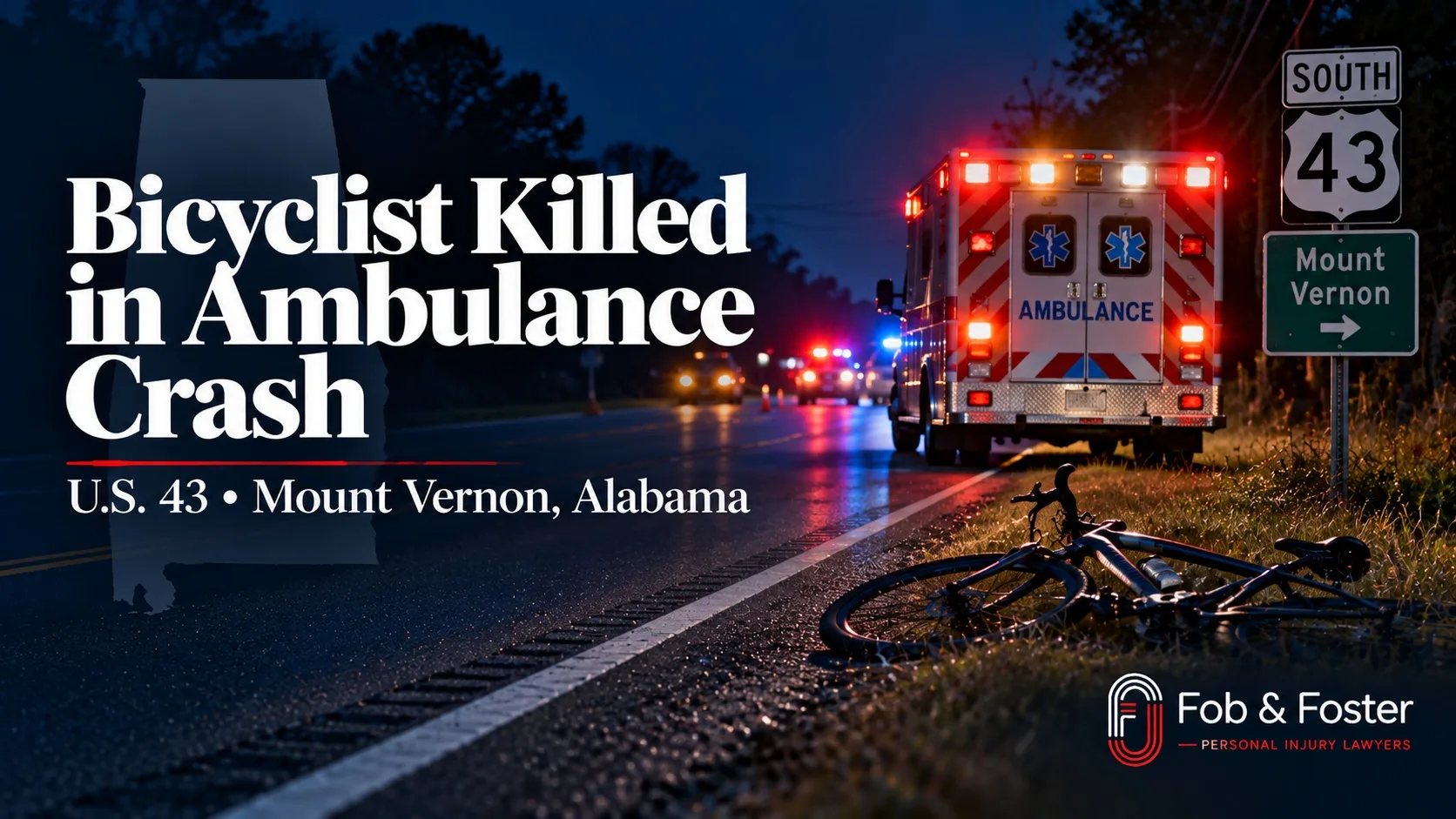
A 19-year-old bicyclist died on the evening of Monday, October 5, 2026, after being struck by an ambulance on U.S. 43 about one mile north of Mount Vernon in Mobile County, according to the Alabama Law Enforcement Agency (ALEA) as reported by FOX10 News and WBRC. ALEA says the ambulance was transferring a patient between hospitals and was not using its lights or sirens. The investigation is ongoing. We extend our deepest sympathies to the young man’s family and friends.
What Happened on U.S. 43 Near Mount Vernon
The crash happened at about 8:15 p.m. near the 29-mile marker of U.S. 43, roughly a mile north of Mount Vernon, according to ALEA. The first dispatch call to Mount Vernon Fire described a motorcycle collision. It was corrected within moments to an ambulance versus a bicycle, so early reports differed on the type of vehicle involved. FOX10 reports that a witness told a 911 dispatcher, “An ambulance hit him.” The bicyclist was pronounced dead at the scene.
Several details are still unknown. Public reports do not say which direction either vehicle was traveling, whether the bicyclist was in a lane or on the shoulder, what lighting the bicycle carried, or whether a helmet was worn. The roughly fifteen minutes between the reported crash time and the first call is also unexplained in the reporting. The ambulance company declined to comment, and ALEA had not released a formal report when the most recent coverage was published on October 14.
One caution on language: when ALEA or the news says a vehicle “struck” a bicyclist, that describes the physical sequence of the collision. It is not a legal finding of fault. Fault is decided on the evidence.
Who May Be Liable
The first question is the ambulance driver. Alabama law gives drivers of authorized emergency vehicles certain privileges under Ala. Code § 32-5A-7, but those privileges are tied to conditions. They apply when the vehicle is responding to an emergency call, pursuing a violator, or responding to a fire alarm, and only while the driver is using the required audible and visual signals. Even then, the driver must use due regard for the safety of all persons, and the statute does not protect a driver from the consequences of reckless disregard for the safety of others. Because ALEA says this ambulance was moving a patient between hospitals without lights or sirens, an investigation will ask whether any emergency privilege applies at all, or whether the driver owed the same duty of ordinary care as any other motorist. That is a question for the evidence, not an assumption.
The second question is the company. An employer can be responsible for the negligence of an employee acting within the scope of the job. Investigators and attorneys will look at who operated and owned the ambulance, how the driver was trained and scheduled, and whether the company followed its own safety policies. Records such as dispatch logs, the vehicle’s electronic data, GPS and camera footage, and driver hours can disappear quickly, which is why early preservation requests matter.
Other factors may matter too: road design, visibility and lighting at the 29-mile marker, and whether any other vehicle was involved. A defense, if raised, would likely point to the bicyclist’s conduct or visibility. Alabama still follows contributory negligence, a common-law rule under which a plaintiff found even slightly at fault can be barred from recovery (Golden v. McCurry, 392 So. 2d 815 (Ala. 1980)). Alabama requires bicycle helmets only for riders under 16, so an adult cyclist without one has not broken the law, though lighting and positioning on the road can still be argued. Families should not assume the outcome either way, and should have the facts reviewed before speaking with any insurer.
For more on cases like this, see our bicycle accident and wrongful death practice pages.
Wrongful Death Rights Under Alabama Law
Alabama’s wrongful death statute, Ala. Code § 6-5-410, allows the personal representative of the person who died to bring a claim when the death was caused by a wrongful act or negligence. The claim must be filed within two years of the date of death (§ 6-5-410(d)), not the date of the crash. Here the death was reported at the scene on October 5, 2026. If a person is injured and survives for a time, a separate personal injury claim carries its own two-year limit from the crash date under § 6-2-38(l).
How Alabama Wrongful Death Damages Are Assessed
Alabama is unusual: wrongful death damages are punitive only. A jury does not award a set amount for funeral costs or lost income. Instead, it considers the seriousness of the wrongful conduct and what is needed to punish it and deter it in the future. That is why the conduct of the driver and the company, including training, policies and decisions made before the trip, can matter as much as the collision itself. Any recovery generally passes to the family under Alabama’s intestate succession rules.
What the Family Should Know Before Speaking With Insurers
Commercial carriers move fast. A claims adjuster may call within days, sound sympathetic, and ask for a recorded statement or a quick release. Statements given early, before the facts are known, can be used to argue the cyclist was at fault. Families should avoid signing anything or giving recorded statements until they understand their rights. It also helps to write down what they know, save messages and photographs, and request the ALEA crash report when it becomes available (see our guide to the Alabama crash report). Because the ambulance was carrying a patient, records about that patient may be protected by medical privacy rules, so legal guidance on how to request records is useful.
Taking the First Step Toward Answers
If your family has questions about this crash or a similar one, call Fob & Foster Personal Injury Lawyers at 205-407-6009 for a free, confidential conversation.
Local Resources for Mobile County Crash Victims and Families
- Mobile County Coroner: 251-470-9912
- Mobile County Sheriff’s Office: 251-574-7827
- Alabama Crime Victims’ Compensation Commission: 1-800-541-9388

Fob James, IV
Fob James obtained a B.S., in software engineering from Auburn University and then continued his education by getting his J.D. from Vanderbilt University School of Law. After working for a large national firm for several years, Fob found that his passion was fighting for individuals who have been seriously injured or wronged by others. Fob believes that the jury is the great equalizer to the power and influence that large corporations have in society. Many of Fob’s cases are high profile and have been featured in, among others: Bloomberg News, PlanAdvisor, AL.com, PlanSponsor, National Law Review, and BusinessInsider. For his work in obtaining numerous multi-million dollar outcomes for his clients, Fob has been recognized by: National Trial Lawyers Top 100, SuperLawyers Rising Star (2020-2026), Birmingham Business Journal Who’s Who in Law (2023-2025), and TrustAnalytica – Top Personal Injury Lawyers in Alabama.