 Alabama Accident News
Shelby County, Alabama | August 25, 2026
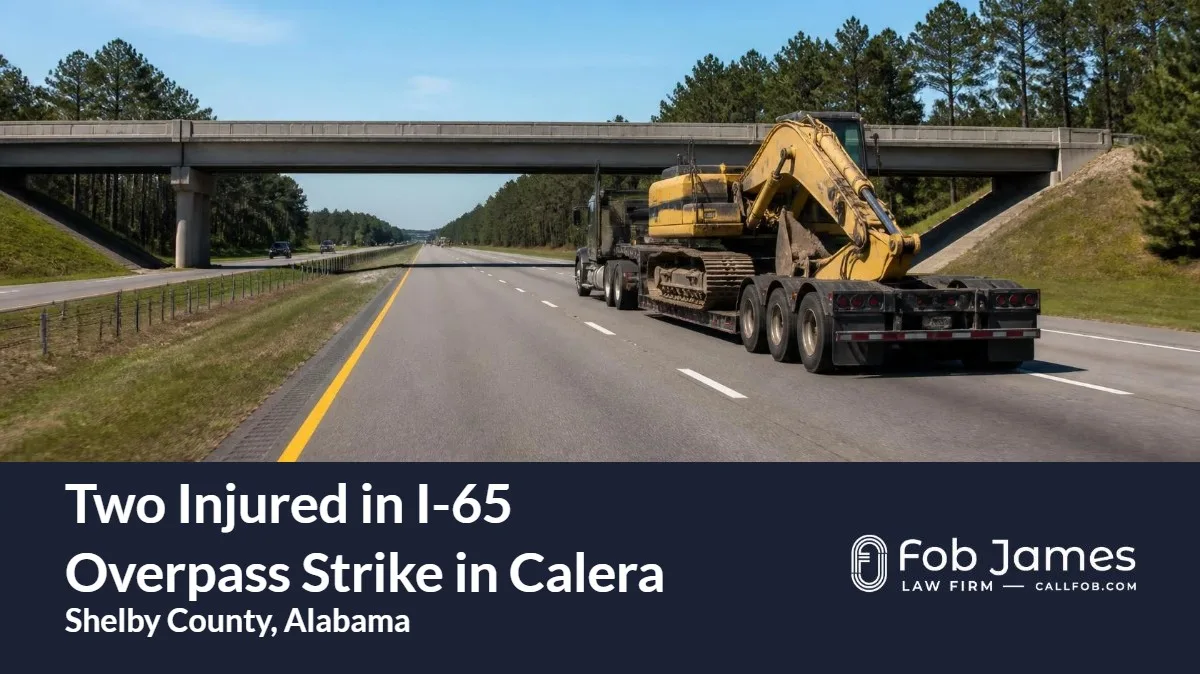
Drivers heading south on Interstate 65 through Calera on Tuesday were doing something completely ordinary: passing under a bridge. Shortly before noon, a piece of construction equipment being hauled down the interstate struck the underside of the County Road 87 overpass at Exit 234. The bridge took a heavy hit, part of it came down, and concrete fell into the travel lanes on people who had no warning and nowhere to go.
Calera Mayor Kenny Dale Cost confirmed that two people were hurt, one of them critically, and that three to four vehicles were damaged. One person was injured when debris came through a windshield. Our thoughts are with the person fighting for their recovery right now, and with every family that got a phone call about that stretch of road on Tuesday afternoon.
What Happened on I-65 at the County Road 87 Overpass
According to the Alabama Department of Transportation, a piece of construction equipment struck the underside of the CR-87 bridge over I-65 at Exit 234 shortly before 12 p.m. on Tuesday, August 25, 2026. ALDOT closed the interstate so crews could clear concrete debris from the roadway and closed the bridge itself while engineers evaluated its structural integrity. Southbound traffic was diverted at Exit 238 in Alabaster, and the backup stretched for hours.
The overpass sits at the northern end of ALDOT’s eight-mile I-65 widening project through Shelby County, a $143 million job running from Calera’s Exit 231 up to the Shelby County Airport interchange at Exit 234. By late Tuesday afternoon, ALEA said the bridge inspection was finished and that officials hoped to reopen I-65 southbound that evening, though the southbound lane of the CR-87 bridge itself stayed closed.
As of this writing, the hauling company, the driver, and the injured motorists have not been publicly identified, and no agency has announced a finding of fault. That is normal this early. It is also worth saying plainly: when an agency describes a load as having “struck” a bridge, that is a description of physical sequence, not a legal conclusion about who is responsible. Fault gets determined later, from permits, routing records, equipment measurements, and the driver’s own conduct.
Who May Be Liable
A bridge strike is not a mystery crash. Overheight loads do not sneak up on anyone. Alabama law sets a hard ceiling on how tall a vehicle and its cargo can be, and it sets out exactly what a carrier has to do before exceeding it. That makes this the kind of case where responsibility is usually provable rather than arguable.
The motor carrier and the driver. Under Ala. Code § 32-9-20(a)(1), no vehicle, semitrailer, or trailer may exceed 13 1/2 feet in height, including its load. Anything taller requires a written permit. The questions that follow are concrete: How tall was the equipment as loaded? Was the trailer deck height accounted for? Did the driver measure the load, or take someone’s word for it? Did the driver have the route and the clearance information in the cab?
Permitting and routing. Ala. Code § 32-9-29 allows the state to issue permits authorizing movement of loads that exceed the statutory limits, and permits for the largest loads come with advance routing requirements. If a permit was issued, its terms are evidence: the approved route, the certified dimensions, any escort or pole-car condition, and any hour-of-day restriction. If the load moved without a permit, or off the permitted route, or taller than the dimensions the carrier certified, that is not a technicality. That is the whole case.
The shipper or equipment owner. Whoever loaded the machine onto the trailer had a role in how tall the finished load sat. Loading decisions, securement, and the accuracy of the dimensions handed to the carrier can all put a second company in the liability picture alongside the trucking company.
Contractors working the corridor. The strike happened inside an active widening project. Whether the equipment was moving to or from that job, and who controlled it at the time, are questions worth asking early, because the answer can add a contractor and its insurer to the list of responsible parties. We have written more about how these layers work in who is liable in an Alabama truck accident.
One more point deserves emphasis, because it matters enormously in Alabama. The people hurt here were driving lawfully in their own lane when concrete fell on them. Alabama is one of a small handful of states that still applies pure contributory negligence, which bars recovery entirely if an injured person is even one percent at fault. That rule comes from the common law and was reaffirmed in Golden v. McCurry, 392 So. 2d 815 (Ala. 1980). It is the defense that kills otherwise strong Alabama cases. It is also close to unavailable to a defendant here, because there is nothing a driver traveling under an overpass could reasonably have done differently.
Injury Claims Under Alabama Law
Alabama gives an injured person two years from the date of the injury to file suit. That deadline comes from Ala. Code § 6-2-38(l), and courts enforce it strictly. Two years sounds like plenty of time. It is not, in a case like this one, because the evidence that decides it starts disappearing almost immediately.
The tractor and trailer will be repaired or returned to service. Electronic logging data and telematics get overwritten on a schedule. The permit file, the dispatch records, the route survey, the pre-trip inspection, the load ticket, the driver’s qualification file, and the equipment’s measured height all live with the carrier and its insurer, and none of it comes to an injured person voluntarily. A preservation letter sent in the first days after a crash is often the difference between a case built on records and a case built on argument.
One statute is worth knowing because insurers still try to work around it. Under Ala. Code § 32-5B-7, failure to wear a seat belt is not admissible as evidence of contributory negligence and does not limit an insurer’s liability. If an adjuster suggests otherwise, the adjuster is wrong.
How Alabama Personal Injury Damages Are Assessed
Alabama personal injury damages are compensatory. They are meant to put an injured person as close to whole as money can, which is a different framework from Alabama’s wrongful death statute, where damages are punitive only.
In practice, a claim arising from an injury like the one reported here would account for emergency and hospital care, surgery, imaging, rehabilitation, and the medical treatment still ahead; lost wages and, where an injury changes what someone can do for a living, lost earning capacity over a working lifetime; physical pain and mental anguish; and permanent impairment or disfigurement. Where a head injury is involved, the honest measure of harm often does not show up for months, which is why a serious brain injury claim should never be valued off the first stack of medical bills.
Alabama also permits punitive damages where a defendant’s conduct rises to the level of wantonness. Whether that standard is met depends on facts not yet public, but it is one of the reasons the permit and routing records matter so much: knowingly moving an overheight load down an interstate is a different kind of conduct than a momentary lapse.
What Injured Drivers and Passengers Should Know
Commercial trucking insurers do not wait. In a high-visibility incident that closed an interstate, a carrier’s rapid-response team can have investigators and photographers at the scene the same day, often before the debris is cleared. Their job is to build the defense file. Nobody is doing that for the people who were hurt unless the people who were hurt arrange it.
Expect a friendly call within days, and expect two requests: a recorded statement, and a signed medical authorization. Both sound routine. A recorded statement taken while someone is medicated, exhausted, and still learning the extent of their injuries produces quotes that get used later. A broad medical authorization hands over years of unrelated records so the insurer can argue the injury predates the crash. Neither is required, and neither has to be answered on the insurer’s timetable.
Early offers deserve the same caution. A quick check that covers the emergency room visit can look like relief in a hard week, but signing a release closes the claim permanently, including for treatment that has not happened yet. In the meantime, a few practical things help: get evaluated even if you walked away feeling fine, keep every bill and out-of-pocket receipt, photograph the vehicle before it is repaired or totaled, write down what you remember while it is fresh, and request the official report. Our guide to obtaining an Alabama crash report walks through how.
Taking the First Step Toward Answers
“A bridge strike is one of the few crashes where the paperwork usually tells you the answer,” said Fob James IV. “There is a permitted height, a permitted route, and a load that either matched them or did not. Families do not need to prove that on their own, but somebody has to go get those records before they age out, and that is the part people miss while they are sitting in a hospital waiting room.”
If you or someone in your family was in one of the vehicles on I-65 Tuesday, you are entitled to understand what happened and who is answerable for it before anyone asks you to sign anything. Fob James Law Firm handles commercial truck and tractor-trailer cases and motor vehicle collision claims across central Alabama, including Alabaster, Pelham, and the rest of Shelby County, and throughout the Birmingham area.
There is no fee unless we recover for you, and a conversation costs nothing. Call 205-407-6009.
Local Resources for Shelby County Crash Victims and Families
- ALEA Highway Patrol, Birmingham Post (covers Shelby County) — 205-635-0006
- ALEA Motor Carrier Safety Unit (commercial vehicle and oversize load matters) — 334-676-6004
- Shelby County Sheriff’s Office — 205-670-6000
- Calera Police Department — 205-668-3505
- Baptist Health Shelby Hospital, Alabaster — 205-620-8100
- UAB Hospital, Birmingham (Level I trauma center) — 205-934-3411
This post is based on reporting from ABC 33/40, WBRC, CBS 42, WSFA, and the Shelby County Reporter, and on statements from ALDOT, ALEA, and the City of Calera, as of August 26, 2026. Details of an ongoing investigation can change. Nothing here is a statement of fault as to any person or company, and nothing here is legal advice.

Fob James, IV
Fob James obtained a B.S., in software engineering from Auburn University and then continued his education by getting his J.D. from Vanderbilt University School of Law. After working for a large national firm for several years, Fob found that his passion was fighting for individuals who have been seriously injured or wronged by others. Fob believes that the jury is the great equalizer to the power and influence that large corporations have in society. Many of Fob’s cases are high profile and have been featured in, among others: Bloomberg News, PlanAdvisor, AL.com, PlanSponsor, InsuranceJournal, and BusinessInsider. For his work in obtaining numerous multi-million dollar outcomes for his clients, Fob has been recognized by: National Trial Lawyers Top 100, SuperLawyers Rising Star (2020-2025), Birmingham Business Journal Who’s Who in Law (2023-2025), and TrustAnalytica – Top Personal Injury Lawyers in Alabama.