
 Articles
Last Updated: October 5, 2026
Update, October 5, 2026: The official terms released after the settlement put Meta’s guaranteed payment at $12.19 billion over ten years, rising to as much as $17.1 billion if TikTok, YouTube and Snap agree to comparable terms, according to Connecticut Attorney General William Tong’s office. Early reports, including the first version of this article, used $16.7 billion; we have corrected the figures below. Since then, TikTok has settled with Alabama for at least $100 million plus teen-safety changes, and 3,824 cases were pending in MDL 3047 as of the October 1, 2026 JPML report. The full timeline is on our social media addiction lawsuit page.
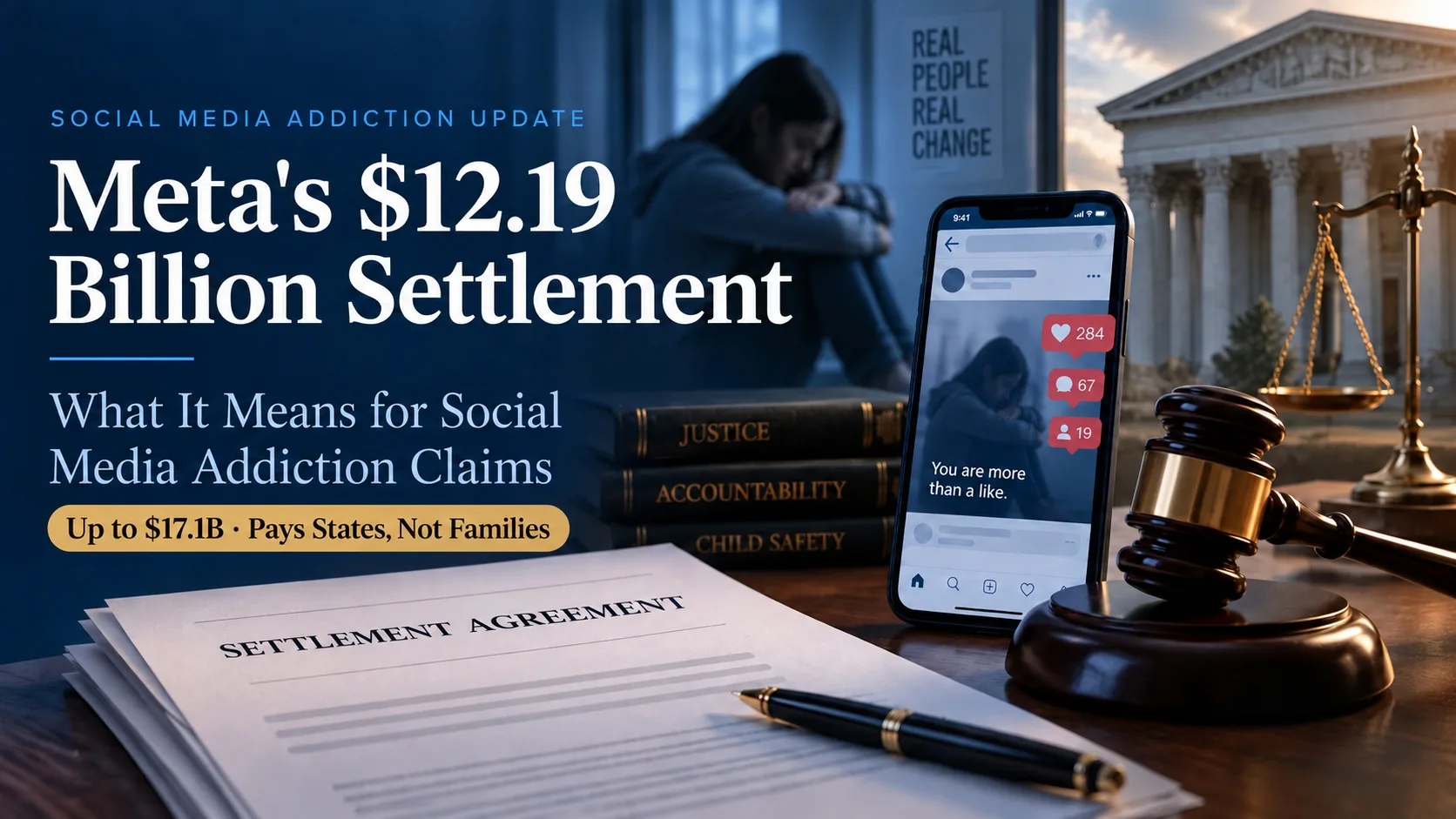
On August 26, 2026, eight days into testimony in Oakland, Meta settled the case brought by 51 state attorneys general. Meta guarantees $12.19 billion over ten years, and the total can reach $17.1 billion if TikTok, YouTube and Snap agree to comparable terms. It is the largest payment any social media company has made over harm to children, and it ended a trial that was supposed to run into October. Our phones started ringing the same afternoon, and most callers asked the same question: what does this mean for my family’s case? The short answer is that it means a great deal for leverage and nothing for your bank account. Here is the longer version.
What Meta Agreed To
The money goes to state governments: $12.19 billion guaranteed over ten years, plus up to $4.91 billion more if the other platforms sign on, with California, Colorado, Kentucky, and New Jersey leading the group that tried the case before Judge Yvonne Gonzalez Rogers. The judge approved the deal within hours of its filing.
The conduct terms matter more for what comes next. For users under 18, Meta agreed to a two-hour default daily limit on Instagram and Facebook, a block from midnight to 6 a.m., no notifications during school hours by default, no public like counts on minors’ posts, no cosmetic-surgery filters, and a feed option with no algorithmic targeting. An independent auditor gets access to Meta’s internal data to check compliance, and Meta is barred from making false or misleading safety claims. Read that list next to the complaints in the federal personal injury litigation and you will notice it is nearly the same list.
What the Settlement Does Not Do
It does not pay a dollar to any individual family. The states sued under their consumer protection and public nuisance laws; the money is a penalty and an abatement fund, not compensation. It does not resolve, dismiss, or affect the roughly 3,200 personal injury cases pending in MDL 3047, the parallel cases in California state court (the JCCP), or the school district suits. And it binds only Meta. TikTok, Snap, and YouTube were not parties, although Meta’s lawyers publicly invited them to adopt the same rules, with financial incentives built into the deal if they do.
Why It Still Matters for Individual Cases
Meta spent two years telling every court that would listen that these claims had no merit and that Section 230 barred them. Then it agreed to pay at least $12.19 billion rather than let a jury of ordinary people decide the question. That is not an admission of liability, and the settlement says so. But it is a price, and prices move negotiations. Every defense lawyer in the MDL now has to explain to a client why a case Meta would not try in Oakland is one it should try in the next bellwether.
The conduct changes cut the same way. Meta has now agreed, in writing, that the design features at the center of the personal injury complaints can be changed: the endless feed, the overnight notifications, the like counts, the filters. A company cannot easily argue those features were essential and unalterable after it altered them to settle a lawsuit.
What Is the Social Media Addiction Lawsuit Payout Per Person?
There is no per-person number, and anyone who quotes one is guessing. The only public jury award in an individual case is the $6 million a Los Angeles jury returned against Meta and Google in March 2026 in the first bellwether. Snap and TikTok settled that case confidentially before trial, and the first school district bellwether settled in May for a reported $27 million. Individual settlements since then have been confidential.
What will eventually set values is the same thing that sets them in every mass tort: the diagnosis, the documentation, and the trial results. A case with a documented eating disorder, self-harm, or a psychiatric hospitalization tied to heavy platform use is worth more than a case with vague anxiety and no treatment records. The next individual bellwether trials on the 2026 calendar will give both sides real numbers to argue from, and the state settlement makes those trials harder for Meta to walk into.
What Families Should Do Now
If your child was diagnosed with depression, anxiety, an eating disorder, self-harm, or suicidal behavior after heavy use of Instagram, TikTok, Snapchat, or YouTube, three things matter this month. First, the deadline. Alabama generally allows two years, Georgia two, Tennessee one, and the clock for a minor’s claim runs differently than an adult’s, so do not assume either way without asking. Second, the records: treatment notes, school records, and the account history itself. Third, do not delete the accounts. The platform data is evidence.
Fob & Foster Personal Injury Lawyers reviews these cases at no cost and takes them on contingency, so there is no fee unless we recover. Call (205) 407-6009 or use the intake form on our Alabama social media addiction lawsuit page.
Frequently Asked Questions
Does the Meta settlement mean my family gets money?
No. The settlement money, $12.19 billion guaranteed and up to $17.1 billion, goes to state governments. Individual claims are separate and are still being litigated in MDL 3047 and the California JCCP.
Does the settlement cover TikTok, Snapchat, or YouTube?
No. Only Meta settled. TikTok, Snap, and YouTube still face the state attorneys general and the personal injury cases, though Meta invited them to adopt the same conduct terms.
Is it too late to file a social media addiction claim?
Usually not, but it depends on your state and your child’s age at diagnosis. Tennessee’s one-year deadline is the tightest. A short call settles the question.
Fob James, IV
Fob James obtained a B.S., in software engineering from Auburn University and then continued his education by getting his J.D. from Vanderbilt University School of Law. After working for a large national firm for several years, Fob found that his passion was fighting for individuals who have been seriously injured or wronged by others. Fob believes that the jury is the great equalizer to the power and influence that large corporations have in society. Many of Fob’s cases are high profile and have been featured in, among others: Bloomberg News, PlanAdvisor, AL.com, PlanSponsor, National Law Review, and BusinessInsider. For his work in obtaining numerous multi-million dollar outcomes for his clients, Fob has been recognized by: National Trial Lawyers Top 100, SuperLawyers Rising Star (2020-2026), Birmingham Business Journal Who’s Who in Law (2023-2025), and TrustAnalytica – Top Personal Injury Lawyers in Alabama.