
 Alabama Accident News
Shelby County, Alabama | September 23, 2026
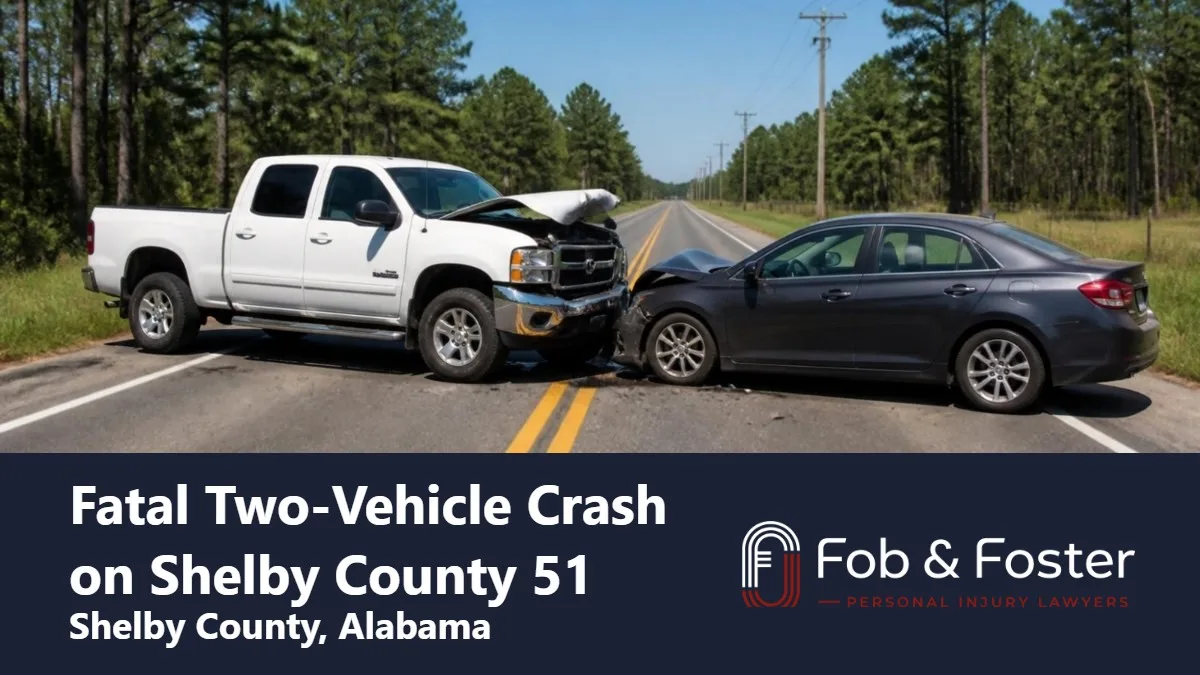
A 70-year-old Harpersville man died on Monday, two days after the pickup truck he was driving was struck by a car on Shelby County 51 in Westover. According to the Alabama Law Enforcement Agency, the collision happened at about 1:38 p.m. on Saturday, September 19, 2026, near U.S. 280, inside the Westover city limits. After the initial impact, the truck left the roadway, struck utility equipment and overturned. He was taken to UAB Hospital in Birmingham and was pronounced dead there on Monday, September 21.
The other vehicle was driven by a 16-year-old. Troopers with ALEA’s Highway Patrol Division are still investigating, and no determination of fault has been announced.
Our condolences go to this man’s family. Losing someone on an ordinary Saturday afternoon a few miles from home is a particular kind of shock, and the days that follow tend to fill up with questions that nobody is prepared to answer.
What Happened on Shelby County 51
What ALEA has released is narrow but specific. A 2015 Ford F-150 was traveling on Shelby County 51 near U.S. 280 when a sedan struck it. The F-150 then left the road, hit utility equipment and rolled over. The driver was not wearing a seat belt and was ejected from the truck. He was the only person reported injured.
Two details in that sequence carry more weight than they might appear to.
The first is the phrase “was struck by.” ALEA uses that language to describe the physical sequence of a collision, meaning which vehicle made contact with which. It is not a legal finding of fault and should not be read as one in either direction. Troopers reconstruct crashes; they do not decide negligence. The full ALEA crash report, once it is available, will contain a great deal more: measurements, point of impact, final vehicle positions, witness statements, and any contributing-circumstance codes the investigating trooper assigned.
The second is the utility equipment. A vehicle that leaves the roadway and strikes a fixed object is undergoing a second collision, separate from the one that sent it there. In a case like this, the injuries that caused death may have come from the rollover and ejection rather than the initial impact. That sequence is not a technicality. It determines which forces did the harm, and it is one of the things a crash reconstruction is for.
Who May Be Liable
Several possibilities are open here, and the investigation has not closed any of them.
The driver of the sedan. Every Alabama driver owes other people on the road a duty of reasonable care. The questions that decide this issue are ordinary ones: speed, lane position, who had the right of way where the two vehicles met, and whether inattention or distraction played a role. Shelby County 51 near the U.S. 280 corridor carries a mix of local and through traffic, and intersection and turning-movement conflicts are common there.
The owner of the sedan, if that is someone other than the driver. Alabama recognizes a common-law claim for negligent entrustment, but it is narrower than people often assume. It is not enough that a driver was young. The claim requires evidence that the person who supplied the vehicle knew, or should have known, that the driver was incompetent to operate it safely. Whether anything like that exists here is unknown. What is worth establishing early, in any crash involving a teenage driver, is who owned the vehicle and which policy covers it.
Whoever is responsible for the utility equipment. If equipment was placed or maintained in a way that made a foreseeable roadway departure more dangerous than it had to be, that can matter. This is a hard claim and frequently goes nowhere. It belongs on the list because it is a question that should be asked, not because the answer is likely to be yes.
There is also a coverage question that often turns out to be the most important one in a case like this. A household policy covering a 16-year-old driver may carry limits nowhere near the value of a death claim. When that happens, uninsured and underinsured motorist coverage on the deceased person’s own policy, and sometimes on policies in his household, frequently becomes the primary source of recovery. Families are often unaware that coverage they paid for applies at all.
The Seat Belt Question Alabama Law Already Answers
ALEA reported that the driver was not using a seat belt and was ejected. An insurance adjuster will raise that fact. Alabama law has already disposed of it.
Under Ala. Code § 32-5B-7, evidence that a person was not wearing a seat belt is not admissible as contributory negligence, and it does not limit an insurer’s liability. Non-use cannot be used to reduce a claim and it cannot be used to defeat one.
Understanding why that protection matters so much requires understanding how unforgiving Alabama is on the subject of fault. Alabama remains one of a small handful of pure contributory negligence states. Under Golden v. McCurry, 392 So. 2d 815 (Ala. 1980), a plaintiff whose own negligence contributed to the injury recovers nothing at all. Not a reduced share. Nothing. There is no percentage apportionment of the kind most states use.
In a state with that rule, any fact an insurer can dress up as fault by the injured person is worth an enormous amount to the insurer, because it is not an argument about discount. It is an argument about zero. That is precisely why the legislature took seat belt non-use off the table by statute. The subject may still come up in conversation. When it does, the answer is a statute, and it is worth knowing that before the phone rings. We have written in more detail about how Alabama’s contributory negligence rule works and why it makes early mistakes so costly.
Wrongful Death Rights Under Alabama Law
Alabama’s wrongful death statute, Ala. Code § 6-5-410, does not work the way most people expect, and it does not work the way most other states’ statutes work.
- The claim belongs to the estate, not to the family individually. Only the personal representative of the estate can bring it, which means someone has to be appointed through the probate court before a lawsuit can be filed. Individual family members, however close, cannot file in their own names.
- Damages are punitive only. This is the part that surprises people most. Alabama does not allow recovery of the family’s economic losses in a wrongful death case. No lost future earnings. No loss of financial support. No compensation for grief or for the loss of a husband, father or grandfather. The statute measures the wrongfulness of the defendant’s conduct and aims at deterrence.
- Proceeds pass under the statute of distribution rather than through the estate, which means they are generally not reachable by the decedent’s creditors.
- The deadline runs two years from the date of death under § 6-5-410(d), not from the date of the crash.
That last point applies directly here. The collision was on September 19 and the death was on September 21. The wrongful death limitations period runs from September 21, 2026. The distinction is small in this case and enormous in cases where someone survives for months or years after a crash.
Had anyone else been injured and survived, their own personal injury claims would run on a different clock: two years from the date of the crash, under Ala. Code § 6-2-38(l).
How Alabama Wrongful Death Damages Are Assessed
Because the damages are punitive, the entire valuation analysis points at the defendant’s conduct rather than at the family’s loss.
A jury is asked how culpable the conduct was. Ordinary inattention sits at one end. Speed, impairment, phone use, or a deliberate traffic violation sit at the other. The distance between a momentary lapse and a conscious disregard for other people’s safety is, in practical terms, the distance between a modest verdict and a very large one.
Families often find this genuinely difficult to hear, and understandably so. Under Alabama law, a well-loved 70-year-old with a long working life and a large family does not generate a larger recovery on that basis. The value of the case turns on what the other driver did.
One practical consequence follows from that. Because everything depends on proving conduct, evidence preservation matters more in Alabama than almost anywhere else. Cell phone records, the event data recorder in each vehicle, scene photographs, and the vehicles themselves all carry the proof. Vehicles get repaired, sold or scrapped within weeks. Recorder data can be overwritten. The window for preserving the evidence that sets the value of an Alabama wrongful death case is often measured in days.
What Families Should Know Before They Talk to an Insurer
An adjuster may call within days of the death, often before the funeral. That call sounds like sympathy and administration. It is neither. Adjusters are trained, competent professionals whose job is to resolve the claim for as little as the file will allow, and in a pure contributory negligence state the tools available to them are unusually powerful.
- Recorded statements. A grieving family member is asked to describe events they did not personally witness. Reasonable uncertainty gets recorded as inconsistency and reappears later as impeachment material.
- The seat belt. Expect it to come up. It is not admissible as contributory negligence and it does not cap the insurer’s exposure.
- Early offers. A number offered before the ALEA report is complete is a number offered before anyone knows what the report says or what coverage exists.
- Paperwork. Medical authorizations are routinely written far more broadly than the claim requires, opening years of unrelated history.
- The truck. Do not let the F-150 be released, repaired or scrapped before it has been inspected and its data preserved. Once it is gone, it is gone.
Families can also request a copy of the crash report at no cost, which is usually the first document worth having.
Taking the First Step Toward Answers
“Families call us in the first week and apologize for bothering us, as though asking what happened to someone they loved is an imposition,” says Fob James, IV. “It isn’t. You are entitled to know what the investigation found, what insurance actually exists, and what Alabama law gives you. And you are entitled to know all of that before anyone asks you to sign anything.”
If your family lost someone in this crash, or in any collision in Shelby County, you can talk it through with a lawyer before you decide anything. There is no cost for the conversation and no obligation that follows it. Call 205-407-6009.
Our firm handles Alabama wrongful death claims and car accident cases throughout Shelby County, including Pelham, Alabaster and Hoover, and across the Birmingham metro.
Local Resources for Shelby County Crash Victims and Families
- Shelby County Coroner — 205-669-3846
- Shelby County Sheriff’s Office, Main Office — 205-670-6000
- UAB Hospital, Birmingham — 205-934-3411
- Baptist Health Shelby Hospital, Alabaster — 205-620-8100
- Alabama Crime Victims Compensation Commission — 1-800-541-9388
ALEA’s Highway Patrol Division is the investigating agency for this crash, and crash reports are requested through ALEA’s records process rather than from the county.

Fob James, IV
Fob James obtained a B.S., in software engineering from Auburn University and then continued his education by getting his J.D. from Vanderbilt University School of Law. After working for a large national firm for several years, Fob found that his passion was fighting for individuals who have been seriously injured or wronged by others. Fob believes that the jury is the great equalizer to the power and influence that large corporations have in society. Many of Fob’s cases are high profile and have been featured in, among others: Bloomberg News, PlanAdvisor, AL.com, PlanSponsor, National Law Review, and BusinessInsider. For his work in obtaining numerous multi-million dollar outcomes for his clients, Fob has been recognized by: National Trial Lawyers Top 100, SuperLawyers Rising Star (2020-2026), Birmingham Business Journal Who’s Who in Law (2023-2025), and TrustAnalytica – Top Personal Injury Lawyers in Alabama.