
 Articles
Why we asked a federal court to step in for six Marine families, what happened, and where to read every filing yourself
Quick Answer
In August 2026, the Department of Justice offered four of our Camp Lejeune clients Elective Option settlements priced as though each had spent less than a year on base. Their certified service records, issued by the government itself, show each was there well over a year, a difference worth $150,000 per family under DOJ’s own payment chart. DOJ found two other clients ineligible and gave two words of explanation: “evidence sufficiency.” When we sent DOJ the service records four days later, it declined to look at them. We asked the court for a hearing. Every judge who has ruled so far denied that request on procedural grounds. Not one found that DOJ’s numbers were right, and in six weeks of briefing DOJ has never said that any of these Marines was on base for less than a year.
If your Elective Option offer does not match your service records, call us before you accept, decline, or let it lapse: (205) 407-6009 or toll-free (866) 837-1010. The consultation is free.
Our motion in the Camp Lejeune water litigation has been covered on public radio and the evening news. This post explains, in our own words, what we filed, why, and how the court ruled. Every brief, exhibit, and order is linked at the end so you can check our account against the record. For background on the program itself, see our explainer, What Is the Camp Lejeune Elective Option?, and for the latest from the court, our Camp Lejeune lawsuit updates.
How the Elective Option Works
In September 2023, DOJ and the Navy created the Elective Option (“EO”), a program for settling Camp Lejeune claims without a trial. The EO is a grid. The amount of each offer depends on the claimant’s illness and on how long the person lived or worked at Camp Lejeune:
| 30 to 364 days | 1 to 5 years | More than 5 years | |
|---|---|---|---|
| Tier 1 (kidney, liver, and bladder cancer, non-Hodgkin lymphoma, leukemias) | $150,000 | $300,000 | $450,000 |
| Tier 2 (multiple myeloma, Parkinson’s disease, kidney disease/ESRD, systemic sclerosis) | $100,000 | $250,000 | $400,000 |
If the illness caused a death, the government adds $100,000. The published guidance says the government will “first internally investigate” each claim using its own records, that claimants with similar exposures and injuries “will receive similar settlement offers,” and that an offer based on “an incorrect length of residence” may be corrected on request within 60 days (FAQ No. 13). Because the amounts are fixed, the time-on-base column is the whole ballgame. Get it wrong and the offer is off by $150,000.
What Happened to Our Clients
In May 2026, DOJ identified our six clients as potentially eligible and gave us 60 days to send supporting documents. We uploaded packets for all six by June 1, and DOJ never told us anything was missing. On August 28, it issued its decisions. Four clients received offers in the lowest time column and were given 30 days to respond, not the 60 the published guidance provides. The table below compares those offers with the government’s own records.
| Client | Certified service records | Gov’t database | DOJ’s sworn form | DOJ offer | DOJ’s own chart |
|---|---|---|---|---|---|
| Client A (bladder cancer) | About 510 days | 457 days | 217 days | $150,000 | $300,000 |
| Client B (kidney cancer) | About 1,156 days | 1,278 days | 318 days | $150,000 | $300,000 |
| Client C (kidney cancer) | About 641 days | Not in filings | Not in filings | $150,000 | $300,000 |
| Client D, estate (kidney cancer, death) | About 737 days | 912 days | 31 days | $250,000 | $400,000 |
The “sworn form” column comes from the Plaintiff Affirmation that DOJ drafted and asked each family to sign under the federal false-statements statute, which warns of “fines, imprisonment.” In Client D’s case, DOJ asked a Marine’s widow to swear that her husband spent 31 days on base. His DD-214, which the government issued, shows three years of active service ending at Camp Lejeune. Three of the four underpriced Marines had told DOJ, in complaints filed nearly two years earlier, that they were on base for well over a year. The fourth, Client D’s estate, had pleaded five months, because a widow cannot be expected to remember where her husband was stationed in 1983. The government had the records. She did not.
DOJ found the other two clients ineligible. One is the estate of a Marine whose death certificate lists bladder cancer as the cause of death, whom the VA had already rated 100% service-connected for that cancer based on his Camp Lejeune service, and whom the government’s own data places on base for 821 days. The other is a Marine whose orders from the Commanding General at Camp Lejeune place him on base from August 1974 to January 1975, and whose bladder cancer is documented in VA records.
DOJ Declined to Look at the Records
On September 1, we sent DOJ the complete service records from the National Personnel Records Center. DOJ replied the next day that it “will not consider additional documentation or re-evaluate any of the cases” and that its decisions were “final.”
Over the next four weeks we asked DOJ, in writing, at least six times how it had calculated these Marines’ time on base. We asked it to keep the offers open while the court considered our motion. The answer was “No.” We asked for the math. The reply restated the offer amounts and ended, “We hope this clarifies any confusion.” We asked to meet, and no one responded. A sworn declaration describing each attempt is linked below.
DOJ has not held other claimants to the same rule. Five weeks before these decisions, it approved a higher offer in another of our cases based on the same kind of service records. On September 2, the same email that said it would re-evaluate none of our cases reported that it had re-reviewed one of them. On September 10, less than two hours after we filed our motion, it made a new offer in a different case using nothing but its own files.
Got an Elective Option offer or denial? Schedule your free consultation today.
(205) 407-6009 or toll-free (866) 837-1010, or contact us online
What DOJ Told the Court
In court, DOJ did not argue that our clients’ dates were wrong. It argued that the program is voluntary, that its guidance “does not have the force and effect of law,” that it is “not required to explain or justify its internal decision-making process,” and that the court has no jurisdiction over the EO at all. On the facts, it said only that it had “verified that its original evaluations of the documents submitted before the deadline were not made in error,” and that any shortfall was our clients’ fault for not proving more by the July 10 document deadline.
Read that sentence carefully. DOJ did not say these Marines were on base for less than a year. It said the packets it had on July 10 did not prove more. The records that prove more belong to the government: service records it issued, a database it maintains, and nearly 100 million pages of digitized muster rolls. The published guidance tells the government to check its own records first: “[i]f eligibility for the EO can be established from government records, then further substantiation is unnecessary.” A deadline for handing the government copies of its own files is met the moment the government opens them.
We do not dispute that DOJ was free to create this program and set its terms. Our position is the one the Supreme Court stated in 2021: “If men must turn square corners when they deal with the government, it cannot be too much to expect the government to turn square corners when it deals with them.” We did not ask the court to force a settlement. We asked for a hearing at which DOJ would state, for each Marine, the dates it used and the records it relied on.
More Families Are Accepting EO Offers
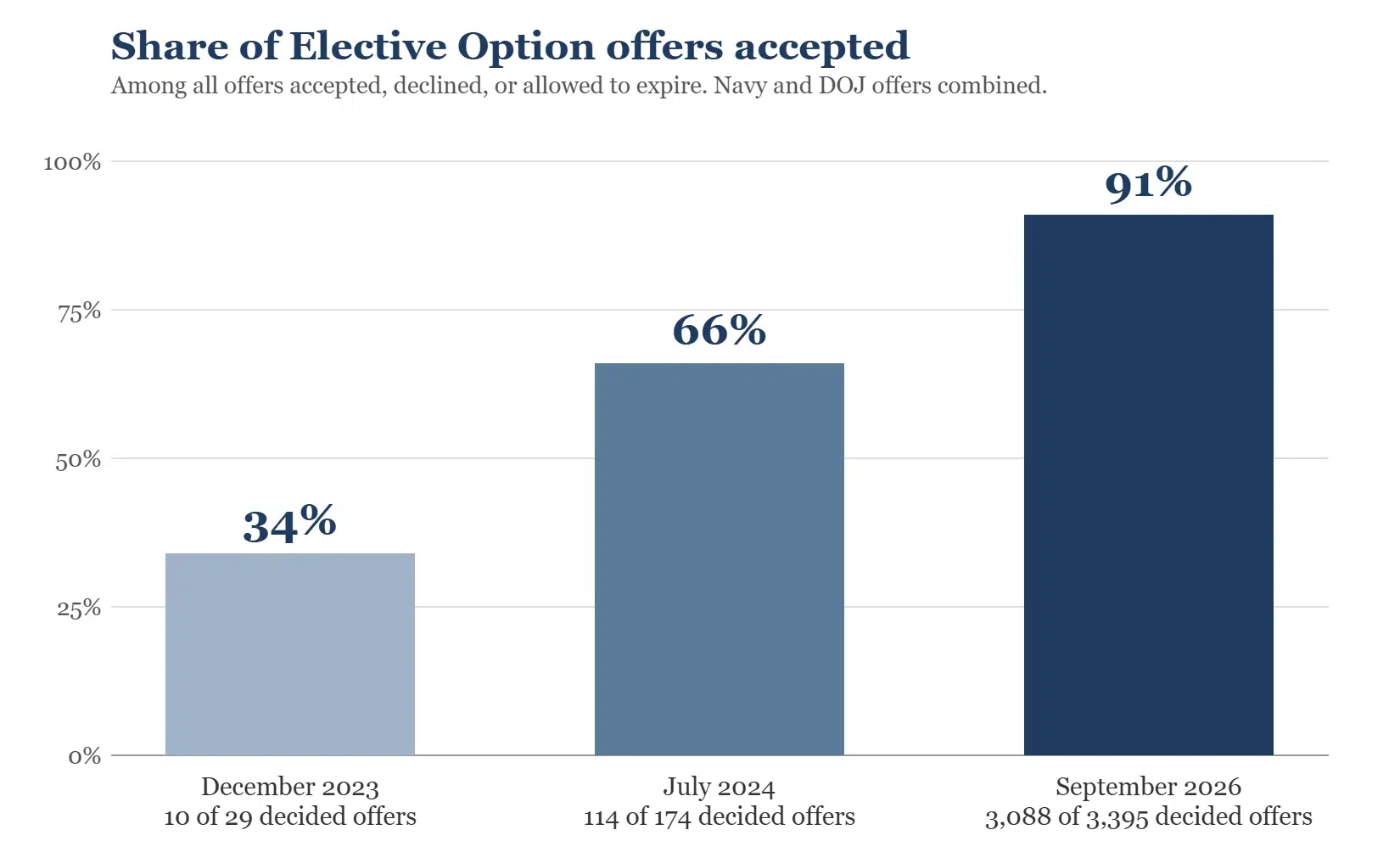
In late 2023, about two of every three EO offers that received a final answer were turned down or allowed to expire. By September 2026, more than nine in ten were accepted. The payment amounts have not changed since 2023. What has changed is the claimants. Many are older and sicker than when the program began, and some have died waiting. Two of our six Marines died before any offer was made. The offer is also hard to walk away from. A Marine who declines must litigate causation and absorb a VA offset that the EO waives, and DOJ’s letters warn that “another EO offer will not be made.” When most families take the first offer they receive, it matters a great deal that the offer is calculated correctly.
Documentation is the bottleneck for everyone. In its September 14 report, DOJ told the court that more than 90% of the Navy claims reviewed so far lack enough documentation to support an EO settlement. At the September 21 status conference, Magistrate Judge Jones said he was “circling the word ninety percent.” A PLG Co-Lead Counsel told him that, given a service number, the digitized muster rolls can show when a Marine was on base “in a heartbeat,” and the PLG has asked DOJ to let all claimants use them. So far, lawyers outside the PLG, including our firm, cannot, even for our own clients.
What the Court Did
The court appointed a group of plaintiffs’ lawyers, the Plaintiffs’ Leadership Group (“PLG”), to lead the litigation. Our firm is not a member. Under the court’s rules, other lawyers may file motions only “with permission from [the PLG] or leave of Court for good cause shown.”
| 2026 | What happened |
|---|---|
| Sept. 10 | We filed our Motion for Hearing on the court’s main docket (the “Master Docket”). |
| Sept. 14 | DOJ argued that we were not “permitted to file in the Master Docket” and that the court “lacks jurisdiction” over the EO. |
| Sept. 15 | We re-filed in all six individual cases and asked the court to rule before the September 27 deadline. |
| Sept. 24 | Magistrate Judge Robert B. Jones, Jr. denied the Master Docket motions without prejudice, finding that we lacked PLG permission and had not properly requested leave. The same day, three families sent DOJ written acceptances at the amounts its own chart provides. |
| Sept. 27 | DOJ’s deadline passed. We filed formal Motions for Leave in each case. |
| Oct. 1 | In one case, Chief Judge Richard E. Myers II denied leave and denied the hearing motion without prejudice, noting that the court “intentionally does not recite the allegations” about the EO. He said the PLG could file a notice confirming it had given permission. |
| Oct. 2 | In two cases, Judge Terrence W. Boyle denied the requests to expedite because September 27 had passed. |
| Oct. 5 | In one case, Judge James C. Dever III denied the motions in a one-page order: “The United States controls its discretionary settlement decisions.” |
| Oct. 13 | In two cases, Judge Louise W. Flanagan found no showing that the court has jurisdiction over the EO process, “much less that the court should intervene in that process.” |
| Pending | The hearing motions in Judge Boyle’s two cases were submitted to him on Oct. 16 and are still pending at the time of this post. |
None of these rulings decided whether DOJ calculated any Marine’s time on base correctly, or whether any of these four Marines spent less than a year at Camp Lejeune. The orders addressed who may file, where, and whether the court should become involved in DOJ’s settlement program at all. Judge Dever’s order said that the United States controls its settlement decisions. It did not address the dates DOJ used.
The PLG’s Role
When the court appointed the PLG, it directed the group to “fairly, effectively, and efficiently represent the interests of all plaintiffs.” As described in our sworn declaration, we sent our draft motion to PLG leadership on September 2. Several PLG attorneys, including Lead Counsel and Co-Lead Counsel, sent revisions, and we incorporated every one. We told them in writing that we planned to file on the Master Docket and asked to be told of any objection. No one objected. At one PLG attorney’s request, we held the filing for his final review.
At the September 21 status conference, the court asked whether the PLG had given permission. A Co-Lead Counsel who had not been involved in the review answered, “I don’t think we opposed it,” and added that he “could stand corrected on that.” The court later ruled that not opposing a motion is different from giving permission. Chief Judge Myers then invited the PLG to file a notice confirming that it had approved the motion. We asked PLG leadership to file one. None was filed.
We understand that the PLG carries a heavy workload, including a global settlement the court has asked it to reach by October 30, and we are not questioning anyone’s motives. Still, the PLG reviewed and edited this motion and did not say so to the judge. That left six families without anyone in leadership willing to put those facts on the record.
Two footnotes in the record are also worth reading. DOJ’s September 14 status report (D.E. 916, n.1) states that our firm “is not part of the PLG and, thus, was not ‘permitted to file in the Master Docket.'” The court’s September 29 order reappointing the PLG (D.E. 925, n.4) warns that actions by lawyers outside the PLG that “impede, undermine, or otherwise have a deleterious effect on the settlement efforts of the PLG are not permitted and shall subject such counsel to sanctions.” The footnote names no one. Families should know, though, that under the current system a lawyer outside leadership who challenges a government error does so at some risk.
Where Things Stand
DOJ’s position is that all four offers expired on September 27. Three of those families sent written acceptances before the deadline at the amounts DOJ’s chart provides for their documented time on base. DOJ treats those letters as rejections, and we have reserved all of our clients’ rights. DOJ has still not said what evidence it found insufficient for the two clients it turned down, or what dates it used for the four it underpaid.
All six lawsuits remain pending and remain part of the broader litigation, including any global settlement. Since we filed, other lawyers and families have contacted us to say the same thing happened to them.
We asked the government to follow the rules it published and to look at its own records. We would make the same decision again. The 1983 Beirut barracks bombing killed 220 Marines, and the country rightly remembers them. Our small firm alone represents the families of nearly twice that many Marines who died of illnesses tied to the water at Camp Lejeune. The least they are owed is an offer computed from their own records.
If You Received an EO Offer
The following is general information, not legal advice. Talk to your lawyer before any deadline passes.
- Compare the time-on-base category in your offer letter with your DD-214 and service record.
- If the affirmation lists dates you believe are wrong, talk to a lawyer before signing it. It is a sworn statement.
- Note your deadline. Recent DOJ offer letters have allowed 30 days, not the 60 described in the published guidance. If your claim was denied, you generally have 180 days to file suit.
- If your offer does not match your records, contact us before you accept, decline, or let it lapse.
Contact Fob & Foster About Your Camp Lejeune Elective Option Offer
Fob & Foster Personal Injury Lawyers represents roughly 700 Camp Lejeune claimants in 48 states from our offices in Birmingham and Mobile, Alabama, and we represent one of the four Track 1 bellwether plaintiffs whose cases are the first set for trial. Every Camp Lejeune case is filed in the Eastern District of North Carolina no matter where you live, so where you live today does not matter.
We charge the 20% or 25% fee the government says the law allows, never more, and if we do not obtain a recovery you owe us nothing. If you have questions about an Elective Option offer, an affirmation you have been asked to sign, or a denial for “evidence sufficiency,” call us at (205) 407-6009 or toll-free (866) 837-1010, or request a free case evaluation online.
In the News
- The National Law Review, “Fob & Foster Represents Camp Lejeune Claimants Challenging Federal Settlement Offers” (Oct. 13, 2026)
- Public Radio East, “Lawyers demand emergency court intervention over Camp Lejeune settlement program” (Sept. 15, 2026)
- Public Radio East, “Camp Lejeune claimants challenge settlement calculations as September 27 deadline approaches” (Sept. 18, 2026)
- WECT News, “‘There’s really no explanation for it’: Former Marines say DOJ lowballed them in Camp Lejeune settlements” (Sept. 28, 2026)
- Public Radio East, “Federal court rejects Camp Lejeune settlement calculation challenge as documentation backlog grows” (Oct. 19, 2026)
Court Filings and Orders
All of the cases below are in the U.S. District Court for the Eastern District of North Carolina. “D.E.” means “docket entry,” the number the court assigns each filing. The same motion papers were filed in each of the six individual cases, so we have posted one copy of each. The orders in every case are posted separately. The individual cases are identified below by case number.
A. Master Docket: In re Camp Lejeune Water Litigation, No. 7:23-cv-897
| Date (2026) | D.E. | Document | Link |
|---|---|---|---|
| Sept. 10 | 913 | Motion for Hearing Regarding DOJ’s Administration of Elective Option Determinations (Foster) | |
| Sept. 10 | 914 | Memorandum of Law in Support (Foster) | |
| Sept. 10 | 914-1 | Ex. A: Public Guidance on the Elective Option (as sent by DOJ, Aug. 28) | |
| Sept. 10 | 914-2 | Ex. B: Elective Option FAQ (as sent by DOJ, Aug. 28) | |
| Sept. 10 | 914-3 | Ex. C: June 22, 2026 status conference transcript excerpts | |
| Sept. 10 | 914-4 | Ex. D: Emails confirming EO packet uploads (May 14 to June 1) | |
| Sept. 10 | 914-5 | Ex. E: DOJ transmittal email (Aug. 28) | |
| Sept. 10 | 914-6 | Ex. F: Emails re grounds for ineligibility (Aug. 28 to 31) | |
| Sept. 10 | 914-7 | Ex. G: Emails with DOJ refusing reconsideration (Aug. 28 to Sept. 3) | |
| Sept. 10 | 914-8 | Ex. H: DOJ Civil Division Camp Lejeune webpage | |
| Sept. 10 | 914-9 | Ex. I: DOJ Press Release No. 26-231 | |
| Sept. 14 | 916 | Joint Status Report (PLG and DOJ); see p. 15 and footnote 1 | |
| Sept. 23 | 919 | Emergency Motion to Stay Sept. 27 Deadline to Respond to EO Offers (Foster) | |
| Sept. 23 | 920 | Memorandum in Support of Emergency Motion, with Exs. 1 to 4 | Memo · Ex. 1 · Ex. 2 · Ex. 3 · Ex. 4 |
| Sept. 23 | 921 | Proposed Order on Emergency Motion | |
| Sept. 24 | 922 | United States’ Memorandum in Opposition to Emergency Motion | |
| Sept. 24 | 923 | Order of Magistrate Judge Jones denying D.E. 913 and 919 without prejudice | |
| Sept. 28 | 924 | Official transcript, Sept. 21 status conference | |
| Sept. 29 | 925 | Order Regarding Reappointment of PLG; see footnote 4 |
B. Motion Papers Filed in All Six Individual Cases
Cases (all 7:24-cv-): No. 00976 (Chief Judge Myers); No. 00982 (Judge Dever); No. 00973 (Judge Flanagan); No. 00969 (Judge Boyle); No. 00978 (Judge Boyle); No. 00919 (Judge Flanagan).
| Date (2026) | Document | D.E. (by case no.) | Link |
|---|---|---|---|
| Sept. 15 | Motion for Hearing re DOJ’s EO Determinations | 976: 6 | 982: 6 | 973: 5 | 969: 7 | 978: 7 | 919: 5 | |
| Sept. 15 | Memorandum in Support, with Exs. A to I (same as Master D.E. 914) | 976: 7 | 982: 7 | 973: 6 | 969: 8 | 978: 8 | 919: 6 | Memo · Ex. A · Ex. B · Ex. C · Ex. D · Ex. E · Ex. F · Ex. G · Ex. H · Ex. I |
| Sept. 15 | Motion to Expedite Consideration and for Interim Relief | 976: 8 | 982: 8 | 973: 7 | 969: 9 | 978: 9 | 919: 7 | |
| Sept. 17 | United States’ Opposition to Motion to Expedite | 976: 10 | 982: 10 | 973: 10 | 969: 11 | 978: 11 | 919: 10 | |
| Sept. 17 | Reply in Support of Motion to Expedite | 976: 11 | 982: 11 | 973: 11 | 969: 12 | 978: 12 | 919: 11 | |
| Sept. 25 | United States’ Opposition to Motion for Hearing (16 pages) | 976: 14 | 982: 13 | 973: 13 | 969: 13 | 978: 14 | 919: 13 | |
| Sept. 27 | Motion for Leave to File Motion for Hearing, Memorandum, and Reply | 976: 15 | 982: 14 | 973: 14 | 969: 14 | 978: 15 | 919: 14 | |
| Sept. 27 | Ex. A: Motion for Hearing; Ex. B: Memorandum of Law | Attachments -1 and -2 to the Motion for Leave | Ex. A · Ex. B |
| Sept. 27 | Ex. C: Reply in Support of Motion for Hearing, with new Exs. J to R (letters, DOJ emails, May 11 DOJ letter, Navy reconsideration emails, Aug. 28 offer packages and affirmations) | Attachment -3 to the Motion for Leave | |
| Sept. 29 | United States’ Opposition to Motion for Leave | 976: 18 | 982: 17 | 973: 17 | 969: 17 | 978: 18 | 919: 17 | |
| Sept. 30 | Reply in Support of Motion for Leave | 976: 19 | 982: 18 | 973: 18 | 969: 18 | 978: 19 | 919: 18 | |
| Sept. 30 | Declaration of James Z. Foster | Attachment -1 to each Reply |
Proposed orders were also filed in each case. They are not posted here.
C. Court Orders in the Individual Cases
| Date (2026) | Case (Judge) | D.E. | Order | Link |
|---|---|---|---|---|
| Sept. 25 | No. 00976 (Chief Judge Myers) | 12 | Order denying Motion to Expedite. Court will consider hearing motion after DOJ responds | |
| Oct. 1 | No. 00976 (Chief Judge Myers) | 20 | Order denying Motion for Leave. Hearing motion denied without prejudice | |
| Oct. 2 | No. 00969 (Judge Boyle) | 19 | Order denying Motion to Expedite | |
| Oct. 2 | No. 00978 (Judge Boyle) | 20 | Order denying Motion to Expedite | |
| Oct. 5 | No. 00982 (Judge Dever) | 19 | Order denying motions: “The United States controls its discretionary settlement decisions.” | |
| Oct. 13 | No. 00973 (Judge Flanagan) | 19 | Order denying motions | |
| Oct. 13 | No. 00919 (Judge Flanagan) | 19 | Order denying motions | |
| Pending | Nos. 00969 and 00978 (Judge Boyle) | n/a | Motions for Hearing and for Leave submitted to Judge Boyle Oct. 16, 2026; no ruling yet | — |
D. The Program Documents DOJ Relied On
- Public Guidance on Elective Option for Camp Lejeune Justice Act Claims (filed as Master D.E. 914-1) (PDF)
- Frequently Asked Questions on the Elective Option, updated Jan. 21, 2025 (filed as Master D.E. 914-2) (PDF)
E. Sources for the Acceptance-Rate Chart
| Date | D.E. | Document | Link |
|---|---|---|---|
| Dec. 19, 2023 | 88 | Joint Status Report | |
| July 30, 2024 | 265 | Joint Status Report | |
| Sept. 14, 2026 | n/a | United States’ Notice of CLJA Settlement Status (submitted under D.E. 290; not separately docketed) |
This article is for general information about a matter our firm is handling. It is not legal advice, and reading it does not create an attorney-client relationship. Every case is different, and past results do not guarantee a similar outcome. We have not used our clients’ names in this article, although the public court filings listed above identify them.

James Z. Foster
James Z. Foster is a partner at Fob & Foster Personal Injury Lawyers and dedicates 100% of his practice to representing injury, mass tort, and wrongful death plaintiffs. Before switching sides, he defended large corporations at one of the world’s largest law firms, and he uses that experience for his clients’ benefit. He is licensed in Alabama, Georgia, and North Carolina and admitted in the Eastern District of North Carolina, where the Camp Lejeune litigation is consolidated. He represents roughly 700 Camp Lejeune claimants, including one of the four Track 1 bellwether plaintiffs, and has been recognized as a Super Lawyers Rising Star (2022-2027) and a National Trial Lawyers Top 40 Under 40. A graduate of the UNC School of Law, James grew up in Raleigh, North Carolina.